
The AI Marketing System Local Businesses Need in 2026 (And What It Actually Includes)
Introduction
“AI marketing” gets thrown around as a buzzword without much clarity on what it actually means for a local business.
Here’s the reality: an AI marketing system isn’t a chatbot on your website. It’s not a social media scheduler. It’s not a dashboard with charts.
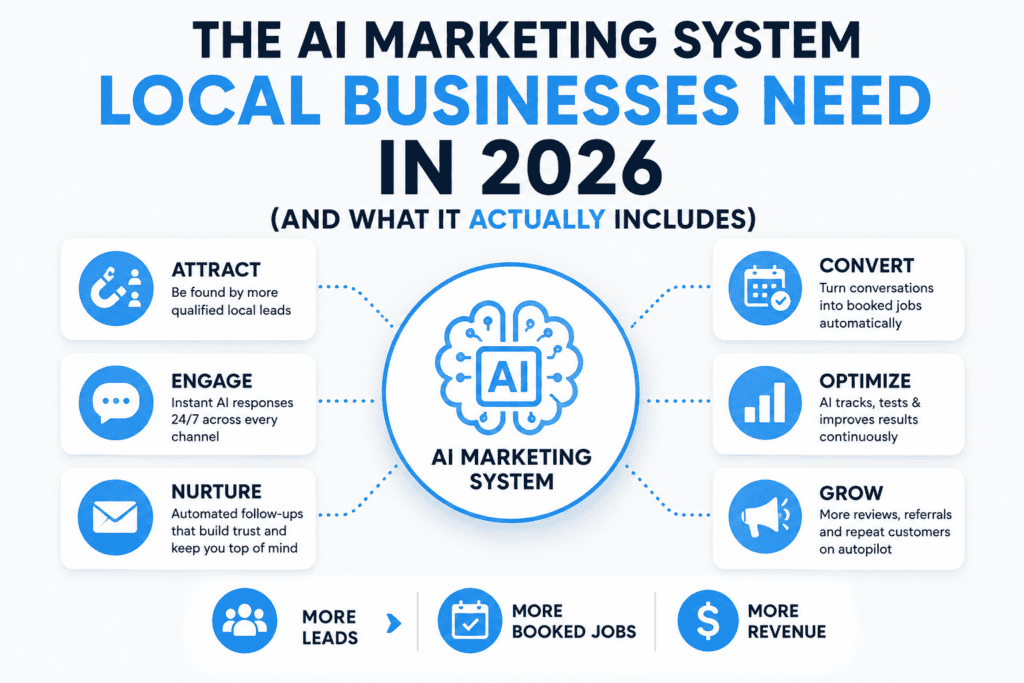
A real AI marketing system for a local business is an integrated set of tools and automation that handles three core functions: getting your business found, capturing every lead that comes in, and following up until each one books or disqualifies themselves.
When those three functions are working together, you have a machine that consistently generates revenue without requiring you to manually manage every step of the process.
This article breaks down what a complete AI marketing system looks like, what each component does, and why each one matters for a local service business in 2026.
Why Local Businesses Need a System, Not Just a Website
The fundamental problem most local businesses face isn’t a lack of leads. It’s a lack of infrastructure to capture and convert the leads they already have access to.
A website that isn’t connected to an automation system is a static brochure. It looks professional. It might even rank on Google. But when a lead lands on it and fills out a form at 9 PM on a Friday, nothing happens. The inquiry sits in an inbox over the weekend. The customer moves on.
The business didn’t lose that lead because their service was bad. They lost it because their system failed.
An AI marketing system solves this by connecting your online presence to an automated back-end that handles lead capture, response, and follow-up without requiring anyone to be at their desk.
The 6 Core Components of an AI Marketing System
1. An AI-Optimized Website
The foundation of any marketing system is a website built to do two things: get found and convert visitors into leads.
Most business websites fail at both.
An AI-optimized website is structured for:
Google SEO — proper keyword targeting, service area pages, technical performance, and structured data that helps Google understand what your business offers and who it serves.
AI search visibility — content structured to answer the questions your customers ask AI. FAQ sections, clear service descriptions, and authoritative content that positions your business as the credible answer when ChatGPT or Google’s AI Overview generates a recommendation.
Conversion — clear calls to action, fast load times, mobile optimization, and trust signals (reviews, photos, credentials) that turn visitors into leads.
A website without these elements is just taking up server space. A website built with these elements becomes an active lead generation asset.
2. Lead Capture System
Getting traffic to your website means nothing if you’re not capturing contact information from visitors who are interested.
An effective lead capture system includes:
- Forms optimized for conversion — not 15-field behemoths, but short, clear forms that ask for what you need and nothing more
- Multiple entry points — forms on every service page, not just the contact page
- Click-to-call integration — a prominently placed phone number that works on mobile with one tap
- Chat or SMS opt-in — giving visitors an easy way to reach out without filling out a form
The goal is to remove every possible barrier between a visitor who’s interested and a lead in your pipeline.
3. Instant AI-Powered Lead Response
This is where AI changes the game for local businesses.
The moment a lead submits your website form, an automated SMS response goes out — within 60 seconds, regardless of time of day or what your team is doing. The message is conversational and personalized to the inquiry.
This does several things simultaneously:
- Confirms receipt — the lead knows you got their message and are on it
- Opens communication — a text exchange is far less friction than waiting for a phone call
- Differentiates you — you’re almost certainly the first business to respond if competitors are relying on manual processes
- Buys time — even if it takes your team 30 minutes to pick up the thread, the conversation has already started
For leads that come in via Meta Ads or other paid channels, the same instant response system fires automatically the moment the lead form is submitted.
4. Multi-Channel Follow-Up Automation
One response isn’t enough. Leads go quiet. Customers get busy. The problem they reached out about temporarily resolves itself.
A complete follow-up system doesn’t give up after one unanswered text. It follows up intelligently across multiple touchpoints over 7–14 days:
SMS sequence — conversational check-ins that re-open the conversation without being pushy. Not “Are you still interested?” but “Hey, just wanted to make sure you got my message — still looking for help with [service]?”
Email nurture sequence — for leads who provided an email, a parallel sequence that delivers value: what to look for in a contractor, what your service includes, testimonials from customers with similar situations. Keeps you top of mind while the lead makes a decision.
Re-engagement campaigns — for leads that went cold after multiple follow-ups, a periodic re-engagement message that gives them an easy way back into the conversation.
The entire sequence runs automatically. Your team’s job is to respond when leads reply — not to manually track who needs a follow-up.
5. Review Generation System
Consistent review generation is a core function of an AI marketing system, not an afterthought.
This component includes:
Automated review requests — triggered by job completion, a personalized SMS goes to the customer asking for a Google review. Sent at the optimal moment: within 24 hours of service completion when satisfaction is highest.
Follow-up for non-responders — a second message 3–4 days later that recovers reviews from customers who meant to leave one and forgot.
Review monitoring — alerts when new reviews come in so your team can respond promptly to both positive and negative reviews.
Why does this belong in a marketing system? Because reviews are now one of the primary signals AI platforms use to determine which businesses to recommend. Automated review generation isn’t just a reputation play — it’s a direct input into your AI search visibility.
6. CRM and Pipeline Visibility
Without a CRM, your lead pipeline is invisible. Leads exist in email inboxes, text threads, sticky notes, and memory. Nothing is tracked systematically. Follow-up is inconsistent. Revenue is hard to forecast.
A CRM connected to your AI marketing system gives you:
- A single view of every lead — where they came from, what they’re interested in, where they are in your follow-up sequence
- Pipeline tracking — how many leads are in each stage, which ones need attention, which ones are close to booking
- Team accountability — visibility into who has been contacted, who has responded, and who needs a call
- Revenue reporting — how many leads are converting, what your close rate is, which channels are generating the most value
This transforms your sales process from reactive (responding when someone happens to reach out) to proactive (knowing exactly which leads are warm and ready for a conversation).
How the System Works Together
Each component is valuable independently. Together, they create something fundamentally different from what most local businesses are operating with.
Here’s what the flow looks like:
- A potential customer searches for your service — on Google, on ChatGPT, or through a Meta Ad
- Your AI-optimized website appears in the results and converts the visitor into a lead
- The lead capture system collects their information and routes it to your CRM
- The instant response system texts them within 60 seconds, opening the conversation
- The follow-up automation continues the conversation across SMS and email over the next 7–14 days
- After the job is complete, the review generation system automatically requests a Google review
- Your growing review base improves your AI search visibility, driving more organic leads over time
Each job completed feeds the system. Every review generated improves your AI ranking. More AI visibility generates more organic leads. The system compounds.
What This System Replaces
For most local businesses, building an AI marketing system means replacing or consolidating several expensive and disconnected tools:
- A static website that doesn’t generate leads → replaced by an AI-optimized lead generation site
- Manual follow-up by whoever gets to the email → replaced by automated SMS + email sequences
- Sporadic, inconsistent review requests → replaced by automated review generation after every job
- Scattered lead tracking in spreadsheets or text threads → replaced by a centralized CRM with full pipeline visibility
The goal is simplicity: one connected system instead of six disconnected tools, each managed by someone with a different priority.
Who This System Is Built For
An AI marketing system is most valuable for local service businesses where the economics of each closed job justify the investment — and where lead volume and competition make a manual approach increasingly untenable.
That includes HVAC companies, plumbers, electricians, roofers, contractors, dental practices, law firms, pest control companies, solar installers, and any other local business where a single closed job generates meaningful revenue.
If your average job value is $500 or more, a system that recovers even one or two additional jobs per month pays for itself several times over.
The Real Advantage: Time
The most underrated benefit of an AI marketing system isn’t the leads it generates. It’s the time it gives back.
When follow-up runs automatically, when review requests send themselves, when your pipeline is visible without digging through email chains — you and your team can focus on what you’re actually good at: serving customers and growing the business.
The businesses that install a complete system early will compound that advantage over the next 2–3 years as AI search continues to reshape how local businesses get found. The ones that wait will spend those years trying to catch up.
Ready to see what an AI marketing system would look like for your business?
Book a free demo at lionbear.ai/book — or get your free AI visibility report at lionbear.ai/visibility-report to see exactly how your business appears in AI search right now.