
 Search Engine Optimization
 Google Maps Ranking
 Google Ads
 Meta Ads
 SEO Websites
 AI Websites
 AI Blog
 AI Guides
 Chiropractors
AI Search Optimization vs SEO: What’s the Difference?
For years, businesses have invested heavily in SEO to improve their visibility online.
The formula was relatively simple. Rank higher in Google, attract more website visitors, generate more leads, and convert those leads into customers.
That strategy still works today.
However, something significant has changed.
Consumers are no longer relying exclusively on traditional search engines to find information. Millions of people now use AI-powered tools such as ChatGPT, Google AI Overviews, Gemini, Claude, and Perplexity to research products, compare services, and discover local businesses.
Instead of searching through multiple websites, users can simply ask a question and receive a direct answer.
This shift is creating a new marketing discipline known as AI Search Optimization.
Many business owners are now asking an important question:
Is AI Search Optimization replacing SEO?
The answer is no.
But businesses that understand the difference between the two will have a major advantage as AI search continues to grow.
What Is SEO?
SEO stands for Search Engine Optimization.
It is the process of improving a website’s visibility in traditional search engines such as Google and Bing.
The goal of SEO is to increase rankings for relevant keywords and attract qualified organic traffic.
SEO strategies typically focus on:
- Keyword research
- Content creation
- On-page optimization
- Technical SEO
- Backlink acquisition
- Internal linking
- User experience
- Local SEO
For example, a roofing company may want to rank for:
- Roof repair
- Roof replacement
- Roofing contractor near me
- Emergency roofing services
An HVAC company may target:
- AC repair
- Heating repair
- HVAC maintenance
- Air conditioning installation
The higher those pages rank, the more opportunities the business has to generate leads.
SEO remains one of the most effective long-term marketing channels available.
What Is AI Search Optimization?
AI Search Optimization focuses on improving visibility within AI-generated answers and recommendations.
Instead of trying to rank a webpage higher in Google, the goal is to increase the likelihood that AI systems reference, recommend, or cite your business.
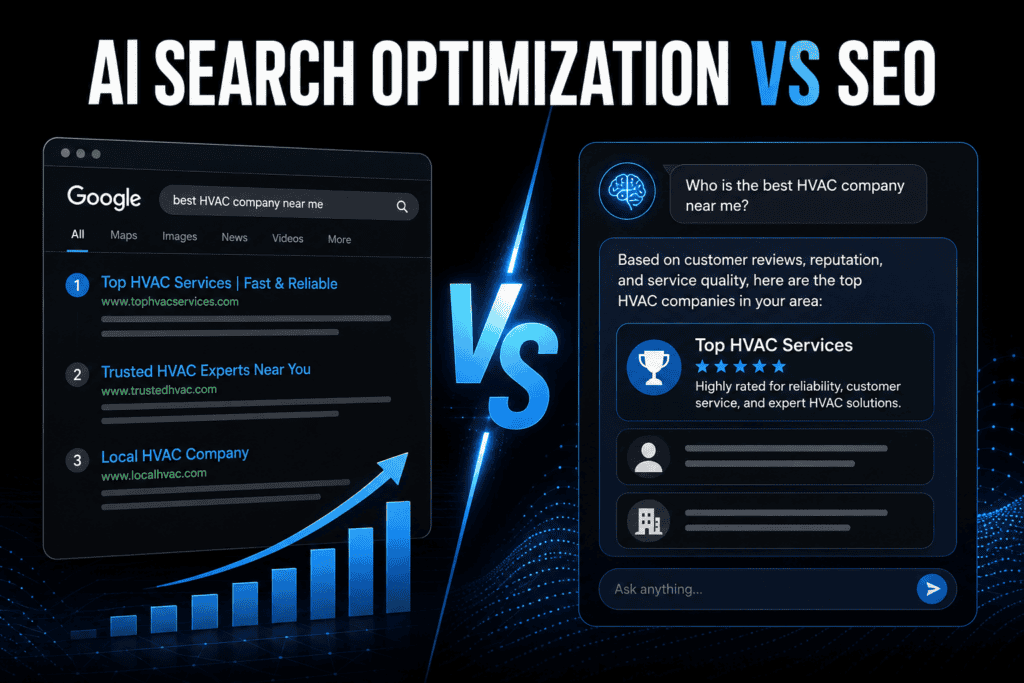
For example, a user may ask:
“Who is the best HVAC company near me?”
Instead of displaying ten blue links, ChatGPT may provide a direct recommendation.
The businesses mentioned in that response gain visibility before the customer ever visits a traditional search engine.
This is why more companies are investing in AI Search Optimization as part of their digital marketing strategy.
The Biggest Difference Between SEO And AI Search Optimization
The easiest way to understand the difference is this:
SEO focuses on ranking webpages.
AI Search Optimization focuses on earning recommendations.
Traditional SEO asks:
“How do I rank this page higher in Google?”
AI Search Optimization asks:
“How do I become the business AI recommends?”
This difference may seem small, but it changes the way businesses think about online visibility.
AI systems evaluate broader authority signals rather than focusing exclusively on webpage rankings.
How Traditional Search Works
When someone searches on Google, the search engine typically follows a process:
- Crawl websites.
- Index content.
- Evaluate ranking signals.
- Display search results.
The user then decides which result they trust.
Google organizes information.
The customer chooses where to click.
Businesses compete for rankings.
How AI Search Works
AI search platforms work differently.
Instead of displaying a list of links, they attempt to provide a direct answer.
This means AI systems must evaluate:
- Authority
- Expertise
- Trustworthiness
- Relevance
- Reputation
The AI becomes the filter between the customer and the information.
Rather than asking users to evaluate ten websites, AI attempts to make that decision on their behalf.
This is why authority matters more than ever.
What SEO And AI Search Optimization Have In Common
The good news is that many traditional SEO best practices also help improve AI visibility.
Both SEO and AI Search Optimization rely heavily on:
- High-quality content
- Website authority
- Reviews
- Brand mentions
- Backlinks
- User experience
- Local relevance
Businesses that have invested in SEO often have a strong foundation for AI search visibility.
The challenge is understanding which additional signals AI systems use when generating recommendations.
Why Reviews Matter More Than Ever
Reviews have always been important for local SEO.
Today, they are even more important.
AI systems use reviews as trust signals when evaluating businesses.
Positive reviews help demonstrate credibility.
Review quantity matters.
Review quality matters.
Review consistency matters.
A business with hundreds of positive reviews sends a stronger trust signal than a competitor with only a handful of reviews.
This is why investing in review management has become a critical part of both SEO and AI visibility strategies.
Why Website Authority Still Matters
Some business owners assume AI search eliminates the need for a strong website.
The opposite is true.
Your website remains one of the strongest authority signals available online.
AI systems often evaluate website content to understand:
- Services offered
- Areas served
- Industry expertise
- Frequently asked questions
- Business credibility
Businesses with outdated websites often struggle to build authority.
Companies investing in AI-powered websites are often better positioned because their websites are optimized for both users and search engines.
The Role Of Content In AI Search
Content remains one of the most important ranking factors in both traditional search and AI search.
Every article you publish helps establish expertise.
For example, a roofing company may publish content about:
- Roof replacement costs
- Storm damage repair
- Roofing materials
- Insurance claims
An HVAC company may publish content about:
- AC maintenance
- Heat pumps
- Indoor air quality
- Energy efficiency
The more useful content your business publishes, the easier it becomes for search engines and AI systems to understand your expertise.
This is one reason businesses investing in AI Search Optimization often focus heavily on educational content.
Local SEO And AI Search
For local businesses, geographic relevance remains critical.
Consumers often ask AI questions such as:
- Who is the best roofer near me?
- What plumber should I call?
- Which HVAC company has the best reviews?
To answer these questions, AI systems evaluate local authority signals.
These include:
- Google Business Profile
- Local citations
- Reviews
- Service area pages
- Local backlinks
Businesses focused on Google Maps Ranking often strengthen many of the same signals AI systems rely on when generating local recommendations.
Why Authority Is Becoming More Important
In traditional SEO, businesses often focused heavily on keyword rankings.
While rankings still matter, AI systems place greater emphasis on authority.
Authority is built through:
- Reviews
- Content
- Backlinks
- Brand mentions
- Citations
- User engagement
- Reputation
The businesses most likely to be recommended by AI are often the businesses that demonstrate the strongest overall authority online.
The Future Is Not SEO Or AI Search Optimization
One of the biggest misconceptions in marketing today is that AI Search Optimization will replace SEO.
That is not happening.
The future belongs to businesses that combine both.
SEO helps businesses rank in traditional search engines.
AI Search Optimization helps businesses become more visible within AI-generated answers.
Together, they create a stronger digital presence.
Businesses that invest in both strategies are likely to outperform competitors that focus exclusively on one.
How Local Businesses Should Prepare
The businesses that benefit most from AI search over the next several years will focus on:
- Building authority
- Generating reviews
- Publishing helpful content
- Improving local visibility
- Strengthening reputation
- Creating better user experiences
These activities support both SEO and AI visibility.
They help businesses rank higher in search engines while also increasing the likelihood of being recommended by AI systems.
Why AI Search Optimization Matters Right Now
AI-powered search is still in its early stages.
That creates an opportunity.
Businesses that begin investing in AI Search Optimization today can establish authority before many competitors even realize the shift is happening.
The companies that adapt early often gain the largest advantage.
Just as businesses that invested in SEO years ago benefited from higher rankings, businesses investing in AI visibility today are positioning themselves for future growth.
Get Your Free AI Visibility Report
Want to know how your business appears in ChatGPT, Google AI Overviews, and other AI-powered search experiences?
LionBear.ai helps local businesses improve visibility through AI Search Optimization, Google Maps Ranking, AI-powered websites, and review management.
Get your free AI Visibility Report today at lionbear.ai/book.
Frequently Asked Questions
Is AI Search Optimization replacing SEO?
No. AI Search Optimization complements SEO. Businesses should invest in both strategies.
Can SEO help improve AI visibility?
Yes. Many SEO signals such as authority, reviews, content quality, and backlinks also influence AI recommendations.
What is the primary goal of AI Search Optimization?
The goal is to increase the likelihood that AI systems recommend, cite, or reference your business.
Do reviews matter for AI search?
Yes. Reviews remain one of the strongest trust signals used by both consumers and AI systems.
Should local businesses focus on SEO or AI Search Optimization?
The most effective strategy combines both. SEO improves traditional search visibility while AI Search Optimization improves visibility within AI-generated answers and recommendations.