
 Search Engine Optimization
 Google Maps Ranking
 Google Ads
 Meta Ads
 SEO Websites
 AI Websites
 AI Blog
 AI Guides
 Chiropractors
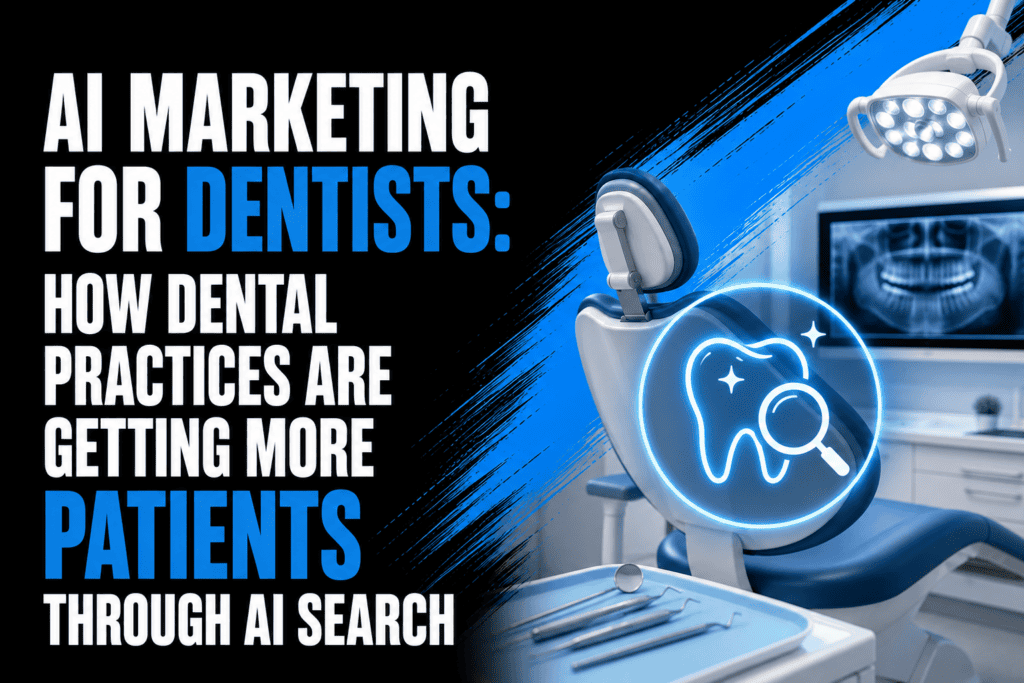
AI Marketing for Dentists: How Dental Practices Are Getting More Patients Through AI Search
The way patients find a new dentist is changing in ways that most dental practices haven’t fully adapted to yet. The traditional path — search Google for dentists near me, scroll through results, check reviews on a few websites, look at before-and-after photos, then call — still exists. But an increasing number of patients, particularly those looking for a new dentist after a move, a change in insurance, or a dental emergency, are taking a shorter route.
They’re asking AI platforms directly. “Find me a dentist near me that takes Delta Dental.” “Who’s the best family dentist in my area?” “I need an emergency dentist — who should I call?” And they’re acting on whatever AI recommends — often without visiting multiple websites or making the extensive comparisons that defined the old research process.
For dental practices, the implications are significant. AI recommendations happen upstream of the traditional patient decision process, capturing patients at the moment of highest intent before any other practice has been considered. The practices appearing in those recommendations are building a patient acquisition advantage that compounds over time. The ones that aren’t are becoming progressively less visible to a growing segment of the patient market — regardless of how long they’ve been established or how many Google reviews they’ve accumulated through passive, unsystematic means.
Why Dental Marketing Is Uniquely Positioned for AI Search Impact
Dental marketing has specific characteristics that make AI search optimization both particularly valuable and particularly well-suited to the way AI platforms evaluate and recommend professional service providers.
Patient Decisions Are Trust-Intensive and Anxiety-Driven
Dental anxiety is one of the most common specific anxieties in the general population — estimates suggest 36% of people experience some level of dental anxiety, with 12% experiencing extreme anxiety. This means that most patients aren’t making dental provider decisions based purely on proximity and convenience. They’re making them based on signals that suggest the practice will be gentle, understanding, professional, and unlikely to cause discomfort or judgment.
AI recommendations that carry these trust signals — built from review language that mentions gentle care, kind staff, clear communication, and anxiety management — carry a form of endorsement that’s particularly powerful for a patient making a trust-intensive healthcare decision. The practice that AI confidently recommends for “dentist good with anxious patients” is positioned as the pre-vetted trustworthy choice before the patient has done any independent research.
Insurance Acceptance Is a Primary Filtering Criterion
A large percentage of dental searches include an insurance qualification — “dentist that takes Cigna,” “dentist accepting Aetna,” “dental office with Delta Dental in-network.” This specificity creates a direct content and profile optimization opportunity: practices that clearly and prominently communicate their insurance acceptance across every platform are matched to these high-specificity searches far more often than those whose insurance information is buried or inconsistent.
AI platforms attempting to answer an insurance-filtered dental search need reliable data about which practices accept which plans. That data comes from your website, your Google Business Profile, your insurance provider directory listings, and any other source where your accepted insurance plans are clearly documented. Practices that provide this information clearly across all of these sources are recommended for insurance-filtered searches. Practices that don’t are invisible to patients whose primary criterion is insurance acceptance.
New Patient Availability Drives Acquisition Opportunities
Patients search for new dentists at specific triggering moments — a recent move, a change in insurance plans, a dental emergency, or an overdue cleaning after a long gap. At each of these moments, “accepting new patients” is a significant qualifying criterion. Practices that clearly communicate new patient availability across their website and Google Business Profile capture these motivated, ready-to-book patients. Practices that don’t communicate this explicitly create unnecessary friction at exactly the moment when a patient is ready to schedule.
How AI Search Is Changing Patient Acquisition for Dental Practices
The shift from traditional search to AI-assisted decision-making is affecting dental patient acquisition in specific, measurable ways that differ from the general AI search trends affecting other local service categories.
Dental searches tend to be less emergency-driven and more deliberate than searches for HVAC or plumbing — which means patients often interact with AI at an earlier stage of their decision process and are more likely to act on the AI recommendation as a starting point for further evaluation rather than as an immediate booking decision. This gives practices that appear in AI recommendations a longer window to capture the patient through their website experience, review profile, and appointment booking process.
The exception is emergency dental searches — a cracked tooth, a lost filling, a severe toothache — where the urgency dynamic mirrors other emergency service searches and the first practice to respond wins the patient at the moment of highest need.
What AI Evaluates When Recommending a Dentist
AI platforms evaluating dental practices weight review volume and the specific language patients use in those reviews most heavily — particularly language addressing anxiety management, staff professionalism, and communication quality. Insurance acceptance information clearly documented across multiple platforms carries specific weight for insurance-filtered searches. Practice-specific service pages covering each specialty and procedure type provide the content matching signals that determine which specific dental searches a practice appears in. Consistent business information across Google Business Profile, Healthgrades, Zocdoc, and other healthcare directories provides the entity clarity that supports confident AI recommendations. And new patient availability communicated explicitly across all platforms captures the high-intent new patient search segment most effectively.
AI Search Optimization for Dental Practices: What to Prioritize
Build Dedicated Pages for Every Procedure and Specialty You Offer
A dental practice website that has one “Services” page listing procedures is significantly underperforming its AI search potential. Every major procedure category and specialty your practice offers deserves its own dedicated page — general dentistry, preventive care, teeth cleaning, dental exams and X-rays, teeth whitening, composite bonding, veneers, dental implants, dental crowns and bridges, root canal treatment, tooth extractions, Invisalign and orthodontics, emergency dental care, pediatric dentistry, and any other procedures you provide.
Each page should answer the specific questions patients have about that procedure: What does the procedure involve? Is it painful? How long does it take? How much does it cost? What’s the recovery like? Who is a good candidate? What are the alternatives? This depth gives AI the content to match your practice to specific procedure searches — a practice with a dedicated dental implant page covering all of these questions will appear in dental implant searches far more often than one whose website just lists “implants” in a services menu.
Make Insurance Information Clear, Complete, and Consistent
Every platform where your practice appears should clearly list which insurance plans you accept. Your website should have a dedicated insurance page or a prominent insurance section that lists every in-network plan. Your Google Business Profile description should reference your major insurance acceptances. Your listings on Healthgrades, Zocdoc, and insurance provider directories should be complete and accurate.
Inconsistency or silence on insurance across these platforms means AI cannot confidently match your practice to insurance-filtered searches — which represent a substantial share of new patient search volume. Getting insurance information right across every platform is one of the clearest, most directly revenue-connected optimizations available to a dental practice.
Optimize Your Google Business Profile for Dental Patient Searches
Your Google Business Profile is one of the primary data sources AI platforms reference when generating dental recommendations. The primary category should be “Dentist” with additional secondary categories for any specialties — “Cosmetic Dentist,” “Pediatric Dentist,” “Emergency Dental Service,” “Orthodontist” — that accurately describe your practice.
The Services section should include detailed descriptions of every procedure you perform — not just category labels. A description of your teeth whitening service that explains what method you use (in-office vs take-home), what results patients can expect, and how long it takes gives AI the specific content to match your practice to whitening searches. The same applies to every other procedure you offer. Practices that complete the Services section thoroughly have a measurable AI search advantage over those that leave it minimal or empty.
Build a Healthcare Directory Presence Beyond Google
Dental practices have access to healthcare-specific directory platforms that carry particular authority for medical AI searches. Healthgrades, Zocdoc, WebMD’s provider directory, Vitals, and RateMDs are the primary platforms. Dental-specific directories like 1-800-Dentist and the American Dental Association member directory add category-specific credibility. Insurance provider directories — your listing in the find-a-dentist tools of the major insurance networks you’re in-network with — function as high-authority citations that directly capture insurance-filtered patient searches.
Ensuring complete, accurate, and consistent information across all of these platforms — matched exactly to your Google Business Profile and website — builds the entity clarity and cross-platform verification that supports confident AI recommendations for dental searches across every platform where patients are searching.
Create Content That Addresses Patient Anxiety and Common Dental Questions
Content that addresses dental anxiety directly — explaining your approach to anxious patients, what sedation options are available, what patients can expect during specific procedures — serves two important purposes. It positions your practice as sensitive to one of the most common patient concerns in the category. And it gives AI the content to match your practice to searches specifically from anxious patients, who represent a large and underserved segment of the dental search market.
Beyond anxiety-specific content, FAQ content that addresses the most common questions across each procedure type creates the question-and-answer structure that AI platforms draw from most readily when generating dental recommendations. “Does a root canal hurt?” “How long do dental implants last?” “What’s the difference between Invisalign and traditional braces?” “Is teeth whitening safe for sensitive teeth?” Each of these questions answered thoroughly adds to the content base AI uses when a patient asks a similar question.
Automated Appointment Follow-Up for Dental Practices
Dental practices face a specific lead capture challenge that most other local service businesses don’t: the potential patient who submits a new patient inquiry during office hours when the front desk is occupied with patients already in the office. A phone ringing at the reception desk while the receptionist is checking in a patient, handling insurance paperwork, or managing a scheduling issue is a call that often goes to voicemail. A potential patient at that moment of decision is a patient who may call another practice before the voicemail is returned.
Instant Response for New Patient Inquiries
An automated lead response system sends an SMS acknowledgment to every website inquiry and form submission within 60 seconds — whether the inquiry came in during office hours, after hours, or on a weekend. For a new patient contact form, this immediate response confirms the practice received their information and lets them know someone will be in touch to schedule their appointment, with an option to book directly online if they’re ready to do so immediately.
For emergency dental inquiries — a patient in pain looking for same-day or next-day availability — the immediate response is particularly critical. Dental emergencies are urgent, pain-driven situations where patients are reaching out to multiple practices simultaneously. The first practice to respond with genuine availability wins the appointment. An automated response that fires within 60 seconds of the inquiry, provides clear next steps, and includes a direct booking link for available appointments captures these high-urgency patients before they’ve committed to a competitor.
Appointment Reminders and Reactivation Sequences
Beyond new patient capture, automated follow-up is valuable throughout the patient lifecycle. Appointment reminders sent 48 hours and again 24 hours before scheduled appointments significantly reduce no-show rates — one of the most costly operational inefficiencies for any appointment-based practice. Patient reactivation sequences that reach out to patients who haven’t scheduled in 12–18 months recover dormant patients who are due for recall but haven’t received a proactive outreach.
These ongoing automated sequences are part of the complete patient lifecycle management that turns a new patient acquisition investment into long-term patient relationships — the basis of a dental practice’s recurring revenue and referral network.
This complete automated infrastructure is part of the LionBear.ai AI marketing system — adapted for the specific scheduling and patient communication needs of dental and healthcare practices.
Review Generation for Dental Practices
Dental reviews are among the most influential trust signals in any healthcare decision — and the specific language in those reviews carries direct AI matching weight for the searches patients most commonly run.
The Language That Drives Dental AI Recommendations
Reviews mentioning “gentle,” “pain-free,” “great with anxious patients,” “explained everything clearly,” “didn’t feel rushed,” “kind staff,” “clean office,” and specific procedure names — “the Invisalign treatment was worth it,” “the implant looks completely natural” — directly address the trust concerns that drive dental provider selection and match the language patients use when asking AI for a dentist recommendation in similar situations.
Reviews that also mention insurance and billing positively — “easy to work with our insurance,” “clear about costs upfront,” “no surprise bills” — carry weight for the significant share of dental searches that include insurance filtering criteria.
Timing and Method for Dental Review Requests
The optimal moment to request a review from a dental patient is immediately after a positive appointment — before they’ve left the office or within a few hours of departure, while the relief of a completed treatment or the satisfaction of a cleaning is still fresh. An automated SMS sent within two to four hours of appointment completion, with a direct link to the Google review page, captures patients at this optimal moment. A follow-up reminder three to four days later for patients who received the initial request but didn’t respond recovers additional reviews from patients who had good intentions but got distracted.
Professional conduct rules around patient privacy vary by jurisdiction — review requests should always be non-specific about the nature of the appointment in order to avoid any suggestion of disclosing protected health information. “How was your experience at [Practice Name] today?” is appropriate. “How did you feel about your root canal?” is not. This distinction matters for compliance and should be built into any automated review request template used by a dental practice.
Frequently Asked Questions About Dental Marketing
How do I get my dental practice to show up in AI search recommendations?
AI recommendation frequency for dental practices is driven by review volume and patient experience language, a fully optimized Google Business Profile with complete procedure descriptions and insurance information, dedicated service pages for every procedure you offer, complete listings on healthcare-specific platforms including Healthgrades and Zocdoc, and accurate insurance provider directory listings. Building these signals systematically over 6–12 months produces meaningful improvement in how often your practice appears in AI recommendations for relevant dental searches.
What should dental practices prioritize first for AI search?
Insurance information consistency across all platforms is the highest-priority first step for most dental practices — because insurance-filtered searches represent a substantial portion of new patient search volume and the gap between having clear insurance information everywhere and not having it is often the difference between appearing in those searches and being invisible to them. After insurance information, review generation and Google Business Profile service descriptions are the highest-leverage priorities for most practices.
How do dental practices handle HIPAA compliance in review requests?
Review requests should be non-specific about the nature of any appointment or treatment — asking about the patient’s general experience at the practice rather than their specific procedure or health condition. The review request itself should not disclose or reference protected health information. Patients can choose to mention specific treatments in their own reviews — that’s the patient’s voluntary disclosure and not a HIPAA concern. The practice’s outreach should always be general and non-specific about clinical details. Consult with a healthcare compliance professional for guidance specific to your jurisdiction and practice type.
Should dental practices use paid search advertising?
Paid search can be valuable for capturing emergency dental searches and for targeting specific high-value procedure keywords like dental implants and Invisalign where the patient lifetime value justifies higher acquisition costs. However, dental paid search in competitive markets can be expensive, and organic and AI search visibility — built through content, reviews, and directory optimization — generates new patient leads at lower ongoing cost. The most sustainable approach treats organic and AI search as the foundation and uses paid advertising to supplement for specific high-value procedures or during new practice growth phases.
The Bottom Line
Dental patient acquisition is shifting alongside every other local service category, with AI-generated recommendations playing a growing role in how new patients find and choose a dental practice. The practices that build AI search visibility now — through procedure-specific content, insurance information consistency, systematic review generation, and automated appointment follow-up — will capture more new patients from this channel as it continues to grow.
The window to build this visibility before competitors do is open right now. The practices that move first will build recommendation momentum that compounds over time, making them increasingly difficult to displace even as more practices eventually adopt AI search optimization strategies.
Want to see how your dental practice currently appears in AI search? Get your free AI visibility report — or book a free demo to see exactly what an AI marketing system would do for your practice’s patient acquisition.