
 Search Engine Optimization
 Google Maps Ranking
 Google Ads
 Meta Ads
 SEO Websites
 AI Websites
 AI Blog
 AI Guides
 Chiropractors
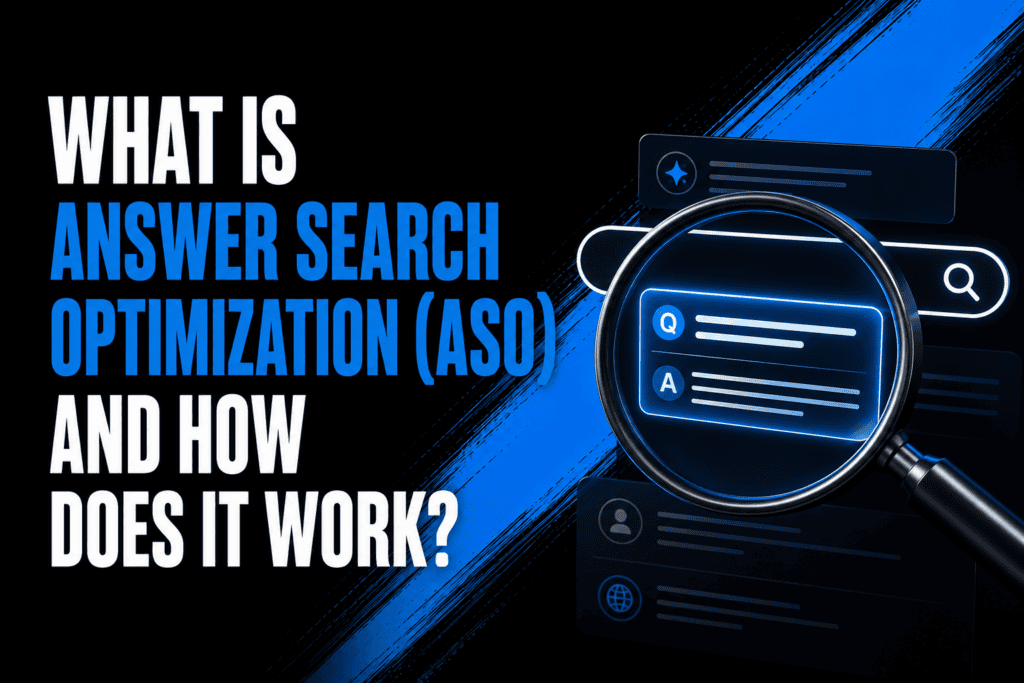
What Is Answer Search Optimization (ASO) and How Does It Work?
Something fundamental has changed in how people search for information and find businesses. For two decades, the dominant behavior was typing a query into a search engine and evaluating a list of results. The consumer did the searching. The search engine organized and ranked the options. The consumer made the selection.
That model is being supplemented — and in many contexts replaced — by something different. People are now asking questions and expecting direct answers. Not a list of links to evaluate. A confident, specific answer to the question they asked. And the platforms delivering those answers aren’t traditional search engines returning ranked results. They’re AI systems generating synthesized responses — ChatGPT, Google AI Overviews, Perplexity, Gemini — that process available information and produce a direct recommendation.
This shift from searching to asking changes what it means to be visible online. And it’s what Answer Search Optimization (ASO) is built to address.
What Is Answer Search Optimization?
AI Search Optimization is the practice of structuring a business’s online presence so that AI platforms include that business in their generated answers when potential customers ask relevant questions.
The word “answer” is central to understanding what makes this different from traditional SEO. Traditional SEO helps businesses rank in search results — the goal is to earn a position on a results page from which a customer might choose to visit your website. ASO helps businesses become the answer — the goal is to be included in the AI-generated response that a customer receives when they ask a question, without the intermediate step of a list to evaluate.
When someone asks ChatGPT “Who’s the best HVAC company near me?” and receives a specific recommendation with a brief explanation of why that business is trustworthy, the business being recommended has achieved what ASO is designed to produce. They’re not on a results page waiting to be clicked. They’re the answer to the customer’s question.
Why the Shift From Searching to Asking Matters
The difference between searching and asking sounds subtle, but the implications for local businesses are significant — and understanding why helps explain why ASO has become a meaningful strategic priority.
The Consumer Decision Journey Has Shortened
When someone searches for a local service on Google and gets a list of results, they go through a decision process: scan the results, click on two or three options, evaluate each website, compare reviews, form an opinion, and eventually choose one to contact. Multiple businesses get consideration time. The consumer remains in control of the selection throughout the process.
When someone asks AI for a recommendation and receives a direct answer, that decision process compresses dramatically. The AI has already synthesized the evaluation. The consumer receives a recommendation that carries the implied authority of an informed source. Many customers act on that recommendation without the multi-step comparison process that traditional search produces.
This compression is powerful for businesses that earn the recommendation — they’re capturing customers earlier in the decision process, with less competitive friction, at the moment of highest intent. And it’s consequential for businesses that don’t earn the recommendation — they’re invisible to a growing segment of customers who complete their decision process before ever seeing a search results page.
AI Recommendations Carry a Different Form of Authority
A customer who finds a business through a Google search knows they made the selection from a list of options. They may have chosen based on position, ad placement, or the attractiveness of the listing. The authority of the choice is largely theirs — they picked from what was presented.
A customer who receives an AI recommendation experiences the choice differently. The AI has done the evaluation on their behalf and delivered a confident, specific suggestion. This carries a form of authority closer to a trusted friend’s recommendation than to a search result — and it produces a different level of customer confidence coming into the first interaction.
For local service businesses, this difference in customer confidence level has downstream effects on conversion rates, close rates, and the quality of the initial customer relationship. AI-referred customers tend to come in with higher trust and lower price sensitivity than customers who found the business by scrolling through a list of ads.
How ASO Differs From Traditional SEO
ASO and SEO share a substantial foundation — the same business signals that support strong Google rankings also contribute to AI recommendation frequency. But the disciplines differ meaningfully in what they optimize for and the specific signals they prioritize.
SEO Optimizes for Position; ASO Optimizes for Inclusion
Traditional SEO is fundamentally about position — ranking higher than competitors for relevant search queries. Success is measured by keyword rankings, organic traffic volume, and conversion rates from search traffic. The competition is for the first, second, or third position on a results page where multiple competitors also appear.
ASO is fundamentally about inclusion — being the business AI chooses to recommend when a relevant question is asked. Success is measured by recommendation frequency across the AI platforms customers use. The competition isn’t for a position on a shared page; it’s for the recommendation itself, which typically goes to one or two businesses rather than ten.
SEO Is Page-Level; ASO Is Presence-Level
Traditional SEO operates primarily at the page level. Individual pages are optimized for specific target keywords. Rankings are tracked page by page and keyword by keyword. A page for “AC repair near me” competes for that specific keyword. A different page competes for “HVAC maintenance agreement.”
ASO operates at the presence level. AI platforms evaluate the cumulative authority of your entire online presence — your website as a whole, your review profile in aggregate, your citation consistency across all directories, your third-party mentions across all sources — to determine whether your business is credible enough to recommend. No single page wins or loses the AI recommendation. It’s the collective strength of all signals that determines recommendation frequency.
SEO Weighs Backlinks; ASO Weighs Reviews and Citations
Backlinks — external websites linking to your content — are among the most important signals in traditional SEO. They function as votes of confidence from other websites that your content is authoritative and worth ranking. The more high-quality backlinks you earn, the stronger your authority signal in Google’s algorithm.
In ASO, the equivalent trust signals are reviews and citations. Review volume, recency, and the specific language customers use in reviews function as the external validation that AI systems interpret as evidence of business quality and credibility. Consistent citations across directories and listing platforms function as the cross-platform verification that AI uses to confirm business legitimacy. Both reviews and citations are more accessible to local businesses than high-quality backlinks — making ASO a more achievable competitive playing field for most local service businesses.
The Core Signals That Drive ASO Performance
Answer Search Optimization is built on five interconnected signal categories that collectively determine how often and how confidently AI platforms recommend a business. Understanding these signals is the practical foundation for building an ASO strategy.
Review Volume and Language
Reviews are the strongest single trust signal in ASO for local businesses. AI platforms evaluate both the quantity of reviews — volume signals legitimacy and operational scale — and the specific language customers use, which functions as the keyword layer that matches your business to relevant searches. An HVAC company whose reviews consistently mention “same-day service,” “responded within the hour,” and “fixed it on the first visit” will be matched to emergency HVAC searches far more often than a competitor with generic reviews, because the language in those reviews directly mirrors what customers ask for in those searches.
Content Depth and Topical Authority
AI platforms evaluate your website’s content for the depth of expertise it demonstrates across your service area. A business with dedicated, detailed pages for every service it offers — each answering the specific questions customers have about that service — demonstrates topical authority that a business with generic, surface-level content doesn’t. The breadth and depth of your content coverage signals to AI whether you’re a credible expert source worth recommending or a business that simply claims to offer the service without demonstrating genuine knowledge of it.
Business Information Consistency
AI platforms cross-reference your business information from dozens of sources — your website, your Google Business Profile, Yelp, Angi, Facebook, industry directories, and more. When that information is perfectly consistent everywhere, AI treats your business as credible and established. When it’s inconsistent — different phone numbers, outdated addresses, varied business name spellings — AI interprets the inconsistency as ambiguity and reduces recommendation confidence. Consistency is one of the most controllable and highest-leverage ASO signals available.
Entity Clarity
AI platforms build an “entity” for each business — a structured understanding of what the business is, what it offers, where it operates, and how trustworthy it is. The clearer and more consistent the entity your business presents across every online touchpoint, the more confidently AI can include it in a recommendation. Entity clarity is built through consistent business information, comprehensive schema markup, complete Google Business Profile data, and a coherent content presence that leaves no ambiguity about what your business does and who it serves.
Third-Party Authority and Mentions
Beyond what you publish about yourself, AI platforms evaluate how widely and credibly your business is mentioned by independent sources. Local news coverage, industry association listings, community mentions, and references from other credible websites all contribute to the external authority signal AI associates with your business. This is the ASO equivalent of backlinks in traditional SEO — external references that tell AI your business is recognized and trusted by sources beyond your own marketing.
How to Implement ASO for a Local Business
ASO implementation involves systematic work across each of the five signal areas — not a one-time optimization but an ongoing process that builds compounding visibility over time.
Build a Review Generation System
Systematic, automated review generation — SMS requests within 24 hours of every completed job, follow-up for non-responders — is the highest-ROI ASO activity for most local businesses. Every review added is another trust data point AI draws from. Every review with specific operational language is another keyword match signal for relevant searches. Reviews compound — the businesses building review volume consistently today have a growing advantage over those that don’t.
Create Comprehensive Service Content
Every service your business offers deserves its own dedicated page with genuine depth — 800–2,000 words that answer the specific questions customers have about that service. Build FAQ content that addresses the questions customers ask AI directly. Structure content in natural, conversational language that mirrors how those questions would be phrased to a chatbot. Publish consistently across blog and resource content that builds topical authority over time.
Optimize Your Google Business Profile
A fully completed, actively maintained Google Business Profile is one of the most directly impactful ASO investments available. Complete service descriptions, accurate categories, regular photo updates, weekly posts, and consistent business information provide AI with structured, reliable data to work from when generating recommendations.
Build Citation Consistency Across the Web
Audit your business information across all major directories and listing platforms. Correct every inconsistency — outdated phone numbers, old addresses, varied business name formats. Submit accurate information to major data aggregators that feed dozens of downstream directories. Build industry-specific directory listings that add category authority to your citation profile. Consistency across 50+ platforms is the citation foundation that AI uses to verify business legitimacy.
Implement Comprehensive Schema Markup
LocalBusiness schema, Service schema, FAQ schema, and Review schema each add layers of explicitly labeled information that AI platforms can parse directly rather than infer from surrounding text. Comprehensive schema reduces the ambiguity that reduces AI recommendation confidence. For WordPress sites, Rank Math handles the baseline LocalBusiness schema. Additional schema types can be implemented through custom JSON-LD using WPCode for pages where Rank Math’s schema slot is already occupied.
ASO and the LionBear.ai Approach
Answer Search Optimization is the strategic framework at the core of everything we build at LionBear.ai. Every component of the LionBear.ai AI marketing system — the AI-optimized website, the review generation system, the Google Business Profile management, the citation building, and the automated lead follow-up — is designed to build and strengthen the ASO signals that determine whether local businesses get recommended when their potential customers ask AI for help.
ASO isn’t a separate campaign or a standalone tactic. It’s a framework for thinking about online visibility in an era where the question “who should I call?” is increasingly being answered by AI before a customer ever opens a search engine.
Frequently Asked Questions About Answer Search Optimization
Is ASO the same as GEO or AI Search Optimization?
ASO, GEO (Generative Engine Optimization), and AI Search Optimization all describe the same fundamental discipline — optimizing for inclusion in AI-generated answers and recommendations rather than traditional search engine rankings. Different practitioners and platforms use different terms for the same concept. At LionBear.ai, we use Answer Search Optimization to emphasize the shift in consumer behavior from searching (looking for options) to asking (expecting a direct answer) that makes this discipline distinct from traditional SEO.
Does traditional SEO still matter if I’m doing ASO?
Yes — significantly. Traditional SEO and ASO are complementary disciplines built on a shared foundation. Strong Google rankings still drive substantial traffic and lead volume for local service businesses. The signals that drive strong SEO performance — authoritative content, consistent citations, quality external references, technical website performance — also contribute to ASO effectiveness. Businesses that pursue both build a compounding visibility advantage across every channel their potential customers use to find them.
How long does it take to see results from ASO?
ASO is a compounding investment rather than a quick-result tactic. Review volume builds gradually with a consistent generation process. Content authority accumulates as pages are published, indexed, and referenced. Citation consistency can be established relatively quickly but requires ongoing maintenance. Most businesses see meaningful improvement in AI recommendation frequency over a 6–12 month period of consistent ASO work, with compounding gains continuing beyond that as overall presence authority grows.
Which AI platforms should I optimize for?
The good news is that the signals that drive recommendations on one AI platform — reviews, content depth, consistent business information, entity clarity — are largely the same signals that drive recommendations across all of them. Optimizing for ChatGPT recommendations also strengthens your visibility in Google AI Overviews, Perplexity, and other AI platforms. The work is not platform-specific; it’s foundation-level, and the foundation serves every AI platform simultaneously.
What’s the most important first step for a business starting ASO?
For most local businesses, the highest-leverage starting point is building a systematic review generation process — automated SMS requests within 24 hours of every completed job. This produces the most direct, measurable improvement in AI recommendation frequency in the shortest timeframe, because reviews are the strongest single ASO signal and the most accessible to build systematically. After review generation is running consistently, the next priorities are completing and optimizing the Google Business Profile and auditing citation consistency across major directories.
The Bottom Line
The shift from searching to asking is real, it’s accelerating, and it’s changing what it means to be visible to local customers. Answer Search Optimization is the discipline that positions local businesses to be the answer — not just a result on a page — when their potential customers ask AI for help.
The businesses that understand ASO and build the underlying signals systematically today will own the recommended positions in their markets as AI-assisted decision-making becomes the standard path to finding a local service provider. The businesses that wait will be catching up against competitors who got there first.
Want to see how your business currently performs in AI-generated answers? Get your free AI visibility report — we’ll show you exactly where you stand across the ASO signals that determine recommendation frequency. Or book a free demo and we’ll walk through a complete ASO strategy built specifically for your business and market.