
 Search Engine Optimization
 Google Maps Ranking
 Google Ads
 Meta Ads
 SEO Websites
 AI Websites
 AI Blog
 AI Guides
 Chiropractors
Generative Engine Optimization: The Next Evolution in Search Visibility for Local Businesses
Search is changing. Not gradually — rapidly. The way people find local businesses is shifting from “search and browse” to “ask and trust.” And the technology driving that shift is generative AI.
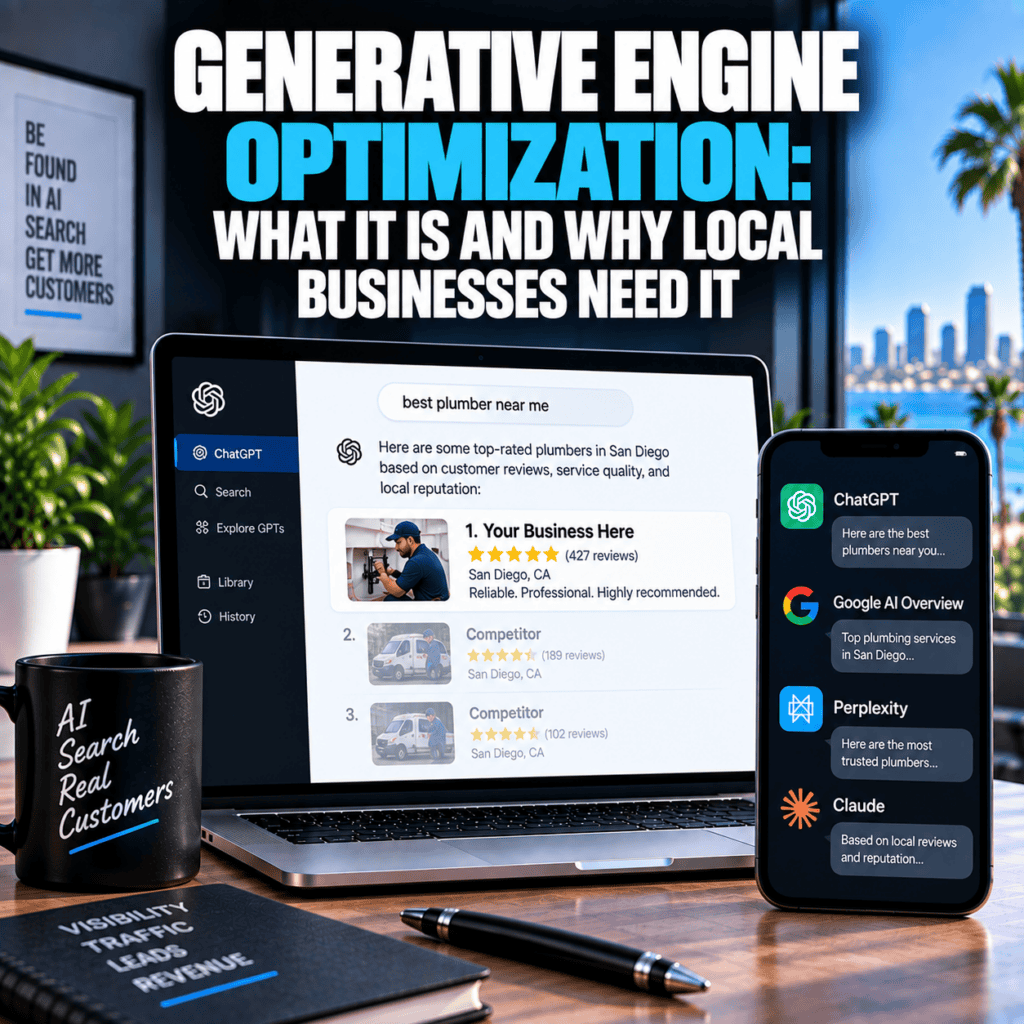
ChatGPT. Google AI Overviews. Perplexity. Microsoft Copilot. Gemini. These aren’t future technologies — they’re fielding billions of queries every month right now. And when a customer asks one of these systems “who’s the best electrician near me” or “recommend a plumber in San Diego,” the AI generates an answer and names specific businesses.
The discipline of optimizing your business to be named in those AI-generated answers is called Generative Engine Optimization, or GEO. It’s the most important emerging category in digital marketing — and it’s where LionBear.ai has focused since before most agencies even started paying attention.
What Is Generative Engine Optimization?
Generative Engine Optimization (GEO) is the practice of optimizing your business’s online presence, content, reputation, and entity signals to increase the frequency with which AI-generated search engines include your business in their responses.
Traditional SEO targets Google’s ranking algorithm — a set of technical and authority signals that determine which web pages appear in search results. GEO targets the trust, authority, and entity recognition signals that determine which businesses AI systems recommend when users ask conversational questions.
GEO is closely related to — and overlaps significantly with — Answer Engine Optimization and our proprietary AI Search Optimization methodology. Together, these form the complete framework for AI visibility at LionBear.ai.
How Generative AI Engines Work — and Why It Matters for Your Business
To understand GEO, you need to understand how these AI systems generate their answers.
Training Data Patterns
Large language models like GPT-4, Gemini, and Claude are trained on enormous datasets scraped from across the internet. These datasets include review sites, directories, news articles, websites, social media, and more. During training, the model learns patterns — including which businesses in which categories in which locations are mentioned most frequently, positively, and consistently.
Businesses with strong, broad, consistent web presence become “recognized entities” in the model’s understanding. Businesses with thin or inconsistent presence are effectively unknown. When a user asks a question that calls for a local business recommendation, the model draws on these learned patterns.
Real-Time Web Search Integration
Most major AI systems now augment their training data with real-time web searches — particularly for local, time-sensitive queries. When someone asks ChatGPT with browsing enabled for “best HVAC company in San Diego,” the model searches the web, pulls information from Google Business Profile, review sites, and websites, and synthesizes a recommendation.
This means your current Google Business Profile, your current Yelp reviews, your current website content — they’re all being referenced in real time. Optimizing these assets isn’t just for Google anymore. It’s for AI.
Entity Recognition and Context
AI models build “entities” — structured knowledge representations of businesses based on all the information they’ve processed. Your business entity includes: what you do, where you’re located, who your customers are, what you’re known for, and how trustworthy you are. A rich, consistent, positive entity profile earns recommendations. A sparse or contradictory entity profile gets ignored.
GEO vs. Traditional SEO: What’s the Same, What’s Different
GEO and traditional SEO share foundational principles but diverge in their specific tactics and measurement. Understanding the difference helps you prioritize the right investments.
What They Share
- Website technical health (speed, mobile optimization, structured data)
- Content quality and depth
- Authority signals (backlinks, citations)
- Google Business Profile optimization
- Review volume and quality
What’s Different in GEO
- Entity clarity over keyword density: GEO prioritizes making your business’s identity unambiguous across the entire web — not just on your own website. Consistency of name, location, services, and specialization across all platforms matters more than keyword placement on individual pages.
- Question-answer content architecture: AI systems reward content that directly and clearly answers questions. The more your content resembles answers to real customer questions, the more likely AI is to cite it.
- Review content optimization: Traditional SEO treats reviews as a secondary ranking signal. In GEO, review content is a primary entity signal — the specific language customers use in reviews shapes the AI’s understanding of what your business does and is known for.
- Brand mention building: Traditional SEO focuses heavily on backlinks. GEO values brand mentions on third-party sites whether or not they contain links — because mentions contribute to entity recognition in AI training data.
- Measurement: Traditional SEO measures search position and organic traffic. GEO measures AI citation frequency — how often your business is named when customers ask AI for recommendations in your category.
The GEO Playbook for Local Service Businesses
Step 1: Audit Your Current AI Visibility
Start by understanding where you currently stand. Ask ChatGPT, Google AI, and Perplexity for recommendations in your category and location. If you’re not mentioned, you have your baseline. If competitors are consistently mentioned, you have your targets.
Our free AI Visibility Report does this audit for you — showing exactly how your business appears across AI systems and where the biggest gaps are.
Step 2: Optimize Your Entity Foundation
Build a consistent, complete, and authoritative presence across every platform where AI looks for business information:
- Google Business Profile: fully optimized, active, posting weekly — see our GBP Optimization service
- Yelp, Angi, BBB, HomeAdvisor, Houzz: complete profiles with consistent NAP
- Facebook Business, LinkedIn: complete, active profiles
- Industry-specific directories relevant to your trade
Step 3: Build Question-Answer Content
Create content on your website — service pages, FAQ pages, blog posts — that directly answers the questions your customers ask AI. For an HVAC company, this means pages that answer: “How much does HVAC repair cost?” “How do I know if my AC needs to be replaced?” “What’s the best HVAC company in San Diego?” For a plumber, it means answers to: “How much does drain cleaning cost?” “Why is my water heater not working?”
Step 4: Build a Systematic Review Engine
Implement automated review generation that sends review requests immediately after job completion, collects high-volume, specific, keyword-rich reviews, and generates fresh reviews consistently. Our Review Management system handles this automatically inside GoHighLevel.
Step 5: Earn Brand Mentions
Get your business name mentioned on third-party websites: local news stories, neighborhood blogs, industry publications, podcast features, community sponsorships. Each legitimate mention on a trusted external site adds to your entity profile. This is where local PR intersects with GEO.
Step 6: Measure and Iterate
Track AI citation frequency monthly. Query ChatGPT, Perplexity, and Google AI for your category and location. Count how often you’re mentioned versus competitors. Track which queries produce citations and which don’t. Use this data to prioritize content and authority-building efforts.
Why Moving Early on GEO Creates a Lasting Advantage
AI models are updated periodically — not in real time. Businesses that build strong entity profiles and high authority signals over the next 12–18 months will be baked into AI models’ understanding of their local category. That’s an advantage that’s very difficult for late movers to overcome.
This is exactly what happened with Google SEO. The businesses that built strong authority early in Google’s history dominated organic search for years. The AI equivalent of that window is open right now — and it won’t stay open forever.
This is why every engagement at LionBear.ai includes GEO alongside traditional SEO, Google Maps ranking, and our complete AI marketing system. The businesses that win the next decade of local search are building these signals right now.
Ready to start? Get your free AI Visibility Report and see exactly where your business stands in generative AI search today. Then talk to the LionBear.ai team about building the system that gets you recommended by AI — consistently and predictably.