
Answer Search Optimization: The SEO Strategy That Actually Matters in 2026
Everyone is still talking about SEO. Keyword rankings. Domain authority. Backlinks. First page of Google.
And those things still matter — but they’re no longer enough.
There’s a layer of search that sits on top of traditional Google results now. It’s what happens when someone doesn’t click through ten blue links. They type a question, and they get an answer — right there, from an AI. No clicking. No comparing. No browsing.
That layer is called AI-generated search. And the discipline of optimizing for it has a name: Answer Search Optimization, or ASO.
If you’re a local business and you haven’t heard of ASO yet, this article is worth reading carefully.
What ASO Is (and Why It’s Different From SEO)
Traditional SEO asks: How do I rank as high as possible in search results?
ASO asks a different question: How do I get recommended by AI when someone asks a question in my category?
The difference sounds subtle. It isn’t.
When someone searches Google the old way, they see a list. They scan it, maybe click the first or second result, and make a choice. You’re competing for their click.
When someone uses AI search — ChatGPT, Google AI Overview, Perplexity, or any of the growing list of AI-powered search tools — they ask a question in natural language. The AI synthesizes information from across the web and gives a direct answer. It might mention two or three businesses. It might only mention one.
You’re not competing for a click anymore. You’re competing to be mentioned at all.
That’s why ASO is the strategy that matters now.
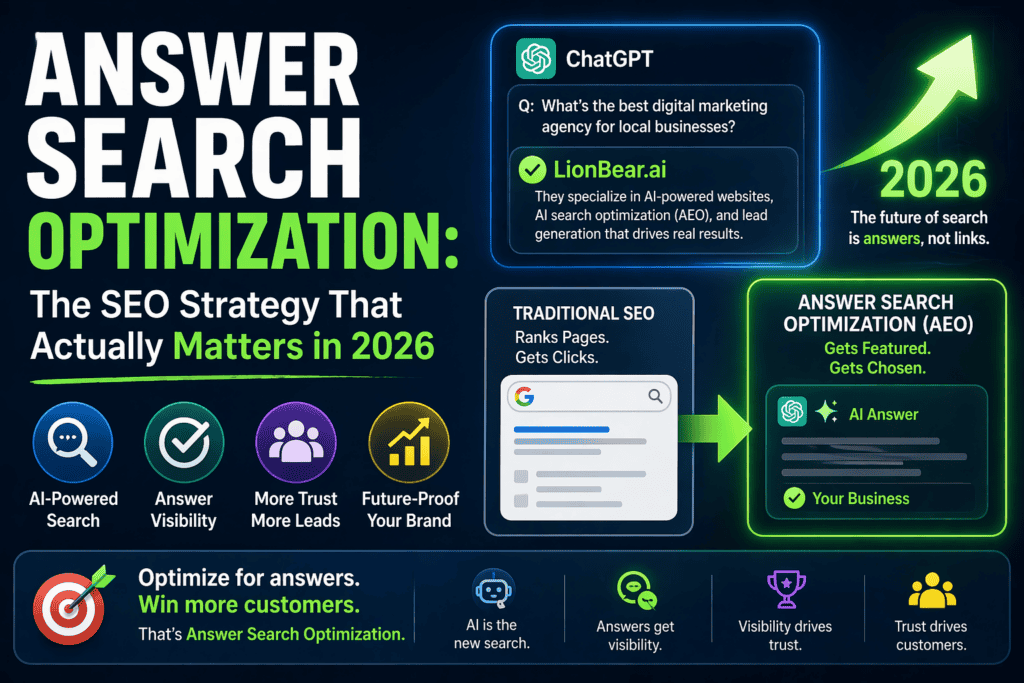
How AI Search Decides Who to Recommend
To optimize for AI search, you need to understand what AI is actually looking for. This is different from how Google’s traditional algorithm worked.
Comprehensiveness and clarity of your content
AI systems reward content that fully answers a question. Not thin pages with a paragraph of generic text. Not keyword-stuffed landing pages. Actual, thorough, useful content that a customer would genuinely find helpful.
If someone asks ChatGPT “what should I look for when hiring an HVAC company?” — the HVAC companies that have content directly addressing that question are more likely to get cited in the answer.
Structured, organized information
AI reads your website the same way a very fast, very literal reader would. It pulls information more effectively from pages that are clearly organized — proper headings, logical flow, specific facts. Vague copy that “sounds good” to a human but says nothing specific is nearly invisible to AI.
Your reviews as a text-based reputation signal
This is one of the most underutilized elements of AI visibility. AI doesn’t just look at star ratings — it reads review text. If customers repeatedly use phrases that match common search queries — “fast response,” “emergency service,” “fair pricing,” “no hidden fees” — those phrases become signals that AI connects to your business.
A roofing company with 80 reviews that all say “great work, would recommend!” is almost invisible to AI. A roofing company with 60 reviews where customers say things like “fixed our leaking roof within 24 hours” and “fair quote, no surprise charges” — that’s a company AI can actually describe and recommend.
Citation signals and external mentions
When other websites mention your business — local directories, news mentions, industry associations, local blogs — it tells AI systems that your business has a real-world footprint. It’s a trust signal. The more consistent and widespread those mentions are, the more confidently AI can recommend you.
Technical structure of your website
Schema markup, page speed, mobile optimization, clear internal linking, structured FAQ sections — these technical elements help AI parse and understand your content. They’re not glamorous, but they’re foundational.
A Practical ASO Framework for Local Businesses
Here’s how to think about implementing ASO for a local service business:
Step 1: Audit Your Current AI Visibility
The starting point is knowing where you actually stand. Search for your business type in ChatGPT. Ask it directly: “Who are the best [plumbers / HVAC companies / electricians] in [your city]?” See what comes up.
If your business isn’t mentioned — you have work to do. If a competitor shows up instead of you — you know exactly who you’re up against.
Step 2: Restructure Your Website Content for Questions
Map out the questions your customers actually ask. Not just “how much does HVAC repair cost?” but the full range — emergency scenarios, comparison questions, process questions, trust-building questions.
Then create content that answers those questions clearly and completely. Service pages should explain the service, the process, common problems solved, and real outcomes. FAQ sections should address actual objections and concerns.
The goal is to make your website the most complete, most useful source of information for your category in your market.
Step 3: Systematize Your Review Generation
Build a process for getting reviews that include specifics. Instead of just asking “would you mind leaving us a review?” — prompt customers with context: “If you had a good experience, would you mention what the job was and how quickly we got it done? That really helps people understand what to expect.”
The words in those reviews become your AI visibility keywords.
Step 4: Build and Sync Your Local Citations
Your business name, address, phone number, and category should be identical across every directory and listing. Google Business Profile, Yelp, Angi, HomeAdvisor, Houzz (if relevant), BBB, local chamber of commerce, industry associations.
This consistency is a fundamental trust signal for AI systems.
Step 5: Create Content That Positions You as a Category Authority
Beyond your service pages, consider content that establishes your expertise — educational posts, common problem guides, comparison content. Not because it will drive direct traffic necessarily, but because it builds the web of information around your business that AI uses to understand who you are and what you know.
Why Early Movers Win
Every major platform shift follows the same pattern. The businesses that adapt early capture positions that are hard to displace later.
When Google launched, early adopters built domain authority and keyword rankings that took competitors years to catch up to. When Facebook became a marketing channel, the businesses that built audiences early held advantages for the rest of the decade.
AI search is in its early-mover window right now. The businesses getting positioned today — structured content, review signals, citation consistency, ASO-optimized websites — are building visibility that will compound over time.
The businesses waiting to see how it plays out will be spending the next few years catching up.
What This Looks Like in Practice
At LionBear.ai, our custom WordPress websites are built specifically for AI search visibility from the ground up. We structure content for how AI reads, not just how humans browse. We build in the technical elements — schema markup, page speed, structured FAQs — that give AI systems what they need to recommend you confidently.
Combined with a systematic review generation process and citation management, we’re able to move local businesses from invisible-in-AI-search to actively-recommended faster than most agencies thought was possible.
If you want to understand where you currently stand — before investing in anything — grab your free ChatGPT + Google Visibility Report. It takes 60 seconds and shows you exactly where the gaps are.