
 Search Engine Optimization
 Google Maps Ranking
 Google Ads
 Meta Ads
 SEO Websites
 AI Websites
 AI Blog
 AI Guides
 Chiropractors
How to Rank Higher on Google Maps — The Complete Guide for Service Businesses
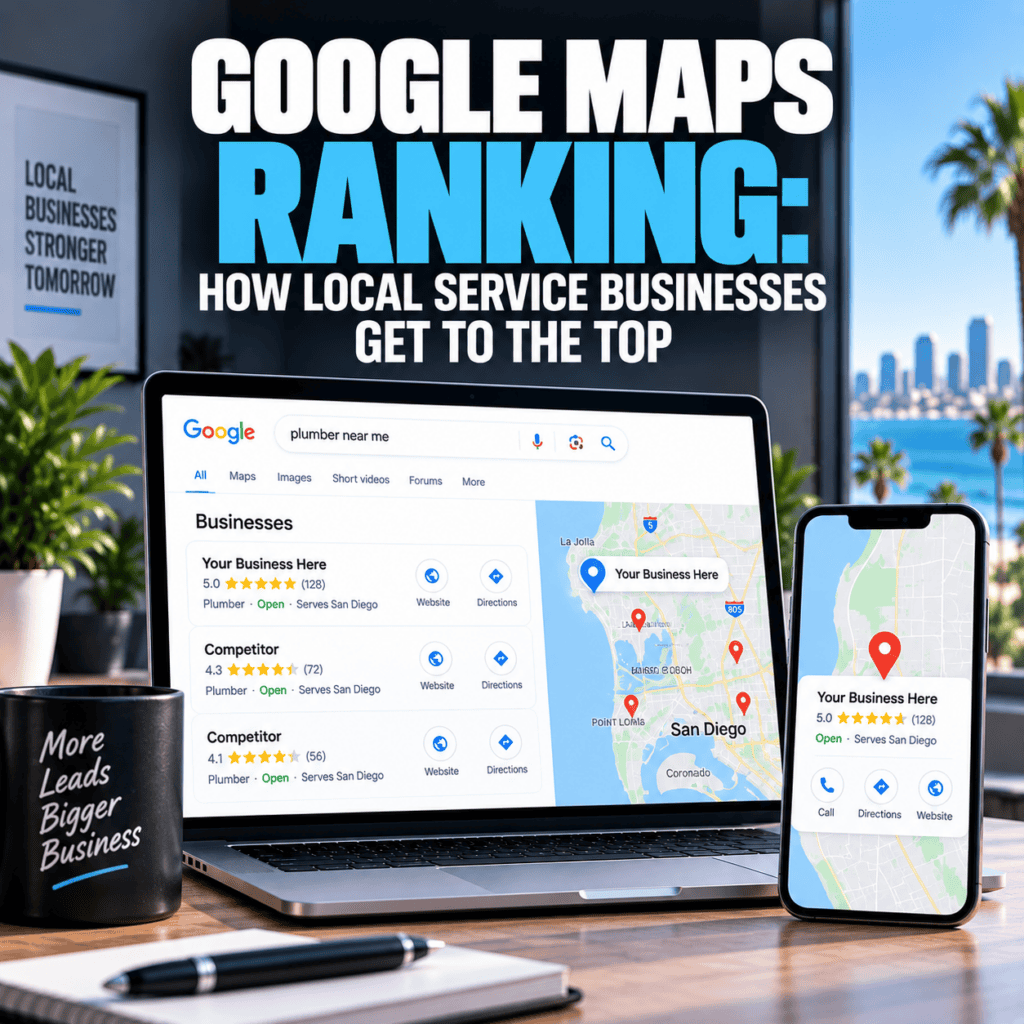
When a homeowner in your city searches “emergency plumber near me” or “best HVAC company,” the first thing they see isn’t a paid ad or a blog post. It’s the Google Maps Local Pack — those three business listings with stars, phone numbers, and map pins that appear above every other result.
That three-pack of local listings gets the majority of all clicks for local service searches. Being in it can fill your calendar. Being outside it means you’re fighting for scraps at the bottom of the page.
This guide covers exactly what drives Google Maps ranking for local service businesses, what Google’s algorithm is actually looking for, and what you can do right now to climb into that top-three position.
Why Google Maps Ranking Matters More Than You Think
Local service searches have a unique characteristic: they’re high-intent and often urgent. Someone searching “water heater repair near me” at 7 PM on a Sunday is not browsing. They have a problem right now and they need someone to fix it. The businesses that show up at the top of Google Maps in that moment win those jobs. The ones that don’t show up, don’t.
Google Maps ranking is also a signal that feeds into AI search recommendations. When ChatGPT or Google AI fields a local business query, Google Business Profile data — which powers Google Maps — is one of the primary data sources it references. A business with strong Maps rankings is also more likely to show up in AI search results.
That’s why we treat Google Maps optimization as a foundational part of every AI marketing engagement at LionBear.ai. It’s not just about local search anymore — it directly influences your AI visibility.
The Three Factors Google Uses to Rank Local Businesses
Google has confirmed that local rankings are driven by three core factors: Relevance, Distance, and Prominence. Here’s what each one means in practice.
1. Relevance: Does Your Profile Match What the Customer Is Searching For?
Google needs to understand exactly what your business does, who it serves, and what services you offer — with zero ambiguity. The more clearly and completely your Google Business Profile communicates your services, the more likely Google is to match your listing to relevant searches.
This means: choosing the right primary and secondary categories, writing a detailed business description that includes your key services and service areas, filling out the products and services section completely, and adding photos that accurately represent your work.
2. Distance: How Close Is Your Business to the Searcher?
Google factors in the physical distance between your business address (or claimed service area) and the person searching. You can’t change where you’re located, but you can expand your service area in GBP to include all cities and neighborhoods you actually serve. This signals to Google that you’re relevant for searches happening across a broader geography.
For service businesses without a physical customer-facing location, setting up a proper service-area business in GBP is critical. Many businesses miss this step and restrict their Google Maps visibility to a tiny radius around their office.
3. Prominence: How Well-Known and Trusted Is Your Business?
This is where most of the optimization opportunity lives. Prominence is Google’s measure of how well-established and trusted a business is — both online and in the real world. The factors that drive prominence include:
- Number and quality of Google reviews
- Responsiveness to reviews (public replies)
- Citations across third-party directories (Yelp, Angi, BBB, etc.)
- Website authority and backlink profile
- Engagement signals on your GBP (clicks, calls, direction requests)
- Google Business Profile post frequency
Improving your prominence is how you move up in Maps rankings even when you can’t change your location. Our GBP Optimization service is built specifically around improving prominence signals systematically.
The Role of Reviews in Google Maps Ranking
Reviews are the single most movable needle in Google Maps ranking. Here’s why they matter so much:
First, review volume: more reviews signal more customers, which signals more trust. A business with 200 reviews consistently outranks a business with 20 reviews in the same category, all else being equal.
Second, review recency: Google weighs recent reviews more heavily than old ones. A business with 50 reviews from the past 3 months outperforms a business with 200 reviews from 3 years ago. This is why review generation needs to be a continuous, automated process — not a one-time push.
Third, review content: the specific words customers use in reviews signal relevance to Google. A plumber with dozens of reviews mentioning “leak repair,” “water heater installation,” and “San Diego” ranks for those terms more strongly than a competitor with the same star rating but vague reviews.
This is why our Review Management system focuses on both volume and content — coaching customers at the moment of asking to use language that reinforces the business’s key services.
Google Business Profile Optimization Checklist
Here’s a practical checklist for getting your GBP fully optimized for better Maps ranking:
Profile Completeness
- Business name matches exactly what’s on your website and other directories
- Primary category is as specific as possible (e.g., “HVAC Contractor” not just “Contractor”)
- All secondary categories are filled in
- Business description is 750 characters and includes primary services + service areas
- Service area covers all cities you actually serve
- Business hours are accurate and complete, including holiday hours
- Products and services section fully populated with descriptions
- All contact information matches website and other directories exactly
Photos
- Minimum 30 photos uploaded (ideally 50+)
- Team photos, vehicle photos, job completion photos
- Photos are geotagged with business location
- Cover photo and logo are high-quality and current
- New photos added monthly
Posts
- Weekly Google Business Profile posts (minimum)
- Mix of offer posts, update posts, and educational posts
- Posts include primary keywords and a clear call to action
Q&A
- Seed Q&A section with 10–15 common customer questions and detailed answers
- Monitor and respond to Q&A submissions from the public
- Use Q&A entries as opportunities to include service keywords naturally
Local Citations: The Hidden Ranking Factor
Your business’s name, address, and phone number (NAP) appear across dozens of online directories — Yelp, Angi, HomeAdvisor, BBB, Yellow Pages, Houzz, Facebook, and many more. Google cross-references these citations to verify that your business information is accurate and consistent.
When your NAP is inconsistent across directories — different phone numbers, slight variations in your business name, old addresses that haven’t been updated — it creates confusion and erodes your trust signals with Google. Fixing these inconsistencies and building new citations on authoritative directories is a direct ranking signal for Google Maps.
This is a core component of our SEO services at LionBear.ai — we audit and clean citation profiles as part of every engagement.
Google Maps Ranking for Specific Industries
Every industry has different competitive landscapes on Google Maps. Some categories are extremely competitive in dense urban markets (plumbers, HVAC in San Diego, for example). Others have lighter competition in certain suburbs and zip codes.
We build industry-specific Maps ranking strategies for:
- HVAC companies — high competition, high job value, emergency search intent
- Plumbers — urgency-driven searches, strong Maps visibility opportunity
- Electricians — less saturated in many markets, strong review opportunity
- Roofers — seasonal spikes, storm event opportunities
- General contractors — project-based, high average job value
- Dentists — location proximity is heavily weighted, reviews are critical
- Chiropractors — high local search volume, strong Maps opportunity
Google Maps + AI Search: The Combined Advantage
Here’s something most businesses don’t realize: Google Maps ranking and AI search visibility are increasingly interconnected. Google AI Overviews pull from Google Maps data when fielding local business queries. A business that ranks strongly in Google Maps is more likely to be cited in Google’s AI-generated answers. A business that earns AI citations gets more clicks, which improves its engagement signals, which strengthens its Google Maps ranking. It’s a flywheel.
This is exactly why our approach combines Maps optimization, AI visibility optimization, and automated lead follow-up into one integrated system. You can learn more about the full approach on our AI Visibility page or get your free Visibility Report to see where you stand today.
Ready to climb the Google Maps rankings and start showing up in AI search? See what LionBear.ai can do for your business.