
 Search Engine Optimization
 Google Maps Ranking
 Google Ads
 Meta Ads
 SEO Websites
 AI Websites
 AI Blog
 AI Guides
 Chiropractors
Answer Engine Optimization: The Strategy That Gets Your Business Recommended by AI
For 20 years, SEO meant one thing: rank on Google’s first page. Get a blue link. Get clicks. That worked — and traditional SEO still matters. But the game has fundamentally changed.
The fastest-growing search behavior today isn’t Google searches. It’s questions asked to AI. ChatGPT has 200 million monthly active users. Google’s AI Overviews appear at the top of most searches. Perplexity, Claude, Microsoft Copilot — they’re all fielding millions of “find me a local business” queries every day.
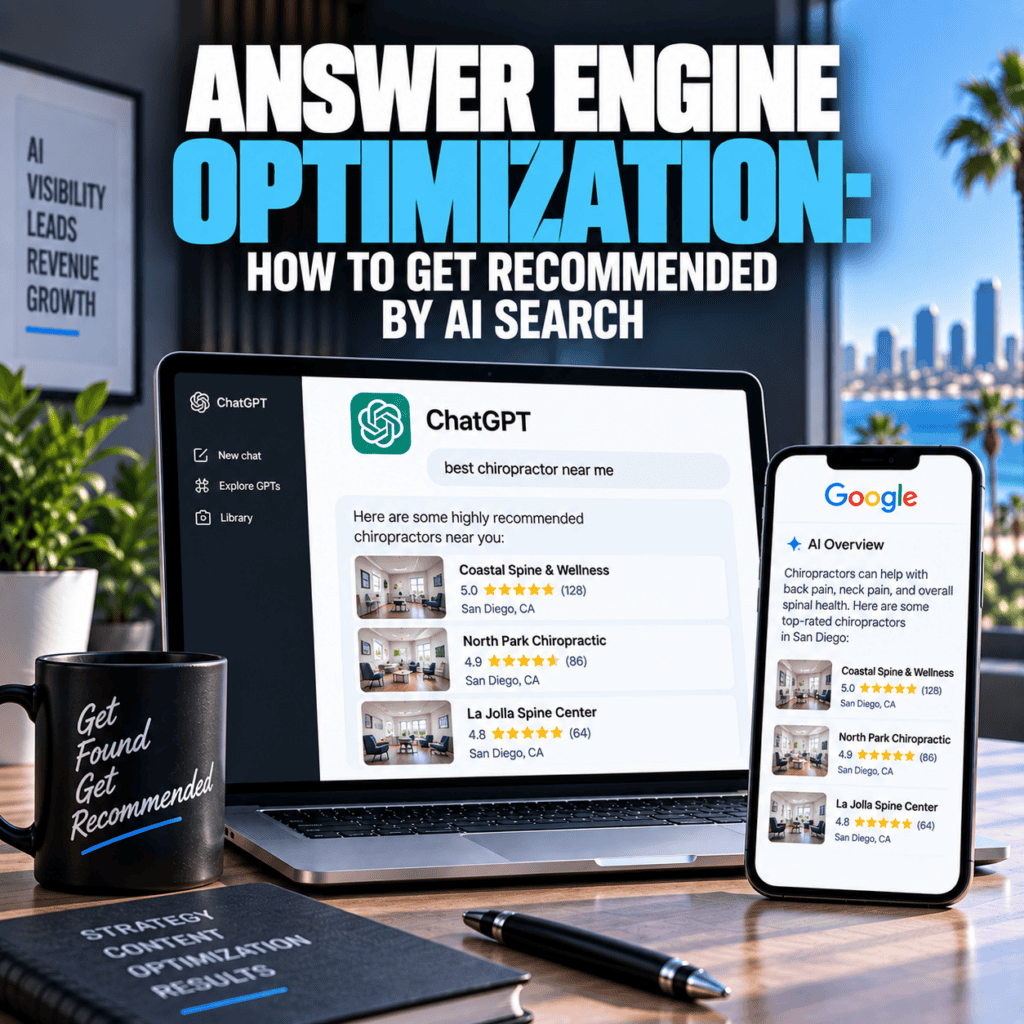
When someone asks AI for a business recommendation, AI doesn’t show ten blue links. It picks businesses and recommends them by name. This is the new frontier. And the strategy for winning it is called Answer Engine Optimization.
What Is Answer Engine Optimization?
Answer Engine Optimization (AEO) is the practice of structuring your business’s online presence, content, and reputation signals so that AI-powered search engines choose to recommend your business in their responses.
Traditional SEO optimizes for search engine ranking algorithms. AEO optimizes for AI recommendation systems — which use a different set of signals to decide who to trust and who to mention.
The key insight: AI doesn’t just crawl your website the way Google’s spider does. It pulls from a much broader ecosystem — your reviews, your citations, your GBP, your brand mentions across the web, your content authority — and synthesizes all of that into a trust score that determines whether you’re worth recommending.
At LionBear.ai, AEO is central to everything we do. Our Answer Engine Optimization service is built specifically to get local service businesses showing up in AI-generated answers.
How AI Answer Engines Decide Who to Recommend
Understanding the mechanism is the first step to optimizing for it. Here’s how major AI answer engines — ChatGPT, Google AI Overviews, Perplexity — approach local business recommendations:
Training Data Recognition
Large language models like GPT-4 are trained on massive datasets scraped from the web. Businesses that appear frequently, consistently, and positively across that data — reviews, directories, news mentions, industry sites — get “recognized” by the model as established, trustworthy entities. Businesses with thin or inconsistent web presence are effectively unknown to the model.
Real-Time Web Search Integration
Many AI systems now supplement their training data with real-time web search — particularly for local business queries where timeliness matters. This means your Google Business Profile, your website, and your Yelp/Angi profiles are being actively referenced when someone asks AI for a local business recommendation right now. Having those assets optimized isn’t optional — it’s how you get cited.
Entity Recognition and Association
AI models build “entities” — mental models of businesses based on all the information they’ve processed about them. Your entity includes: what you do, where you do it, who your customers are, how trustworthy you are, and what you’re known for. A business with a rich, consistent, positive entity profile earns recommendations. A business with a sparse or confused entity profile gets ignored.
Review Content as a Trust Signal
AI systems read review content — not just ratings. The specific phrases your customers use in reviews become associated with your business entity. A roofing company with reviews mentioning “showed up same day after the storm” and “best roofer in San Diego” is building an AI entity that earns recommendation for those specific use cases. Our Review Management system is designed to generate this exact type of review content at scale.
Answer Engine Optimization vs. Traditional SEO
AEO and traditional SEO share many foundational elements — quality content, authoritative backlinks, technical website health — but they diverge in important ways.
| Traditional SEO | Answer Engine Optimization |
|---|---|
| Optimizes for keyword rankings | Optimizes for AI recommendation inclusion |
| Targets Google’s ranking algorithm | Targets AI model trust signals |
| Measured by search position | Measured by AI citation frequency |
| Content optimized for keywords | Content optimized to answer questions directly |
| Links and on-page factors drive authority | Reviews, mentions, and entity signals drive authority |
This is closely related to what we call Generative Engine Optimization — the broader category of optimizing for AI-generated content and recommendations across all generative AI systems.
The Five Pillars of Answer Engine Optimization for Local Businesses
Pillar 1: Question-Answer Content
AI systems are built to answer questions. When a user asks “who is the best HVAC company in San Diego?” the AI searches its knowledge base for content that directly answers that question. Creating content on your website that matches the exact questions your customers ask — and answers them clearly and specifically — is the most direct way to get cited in AI responses.
This means FAQ pages, detailed service pages that answer “what does this service include?” and “how much does it cost?” and blog posts that answer the specific questions your customers ask most. Our AI Websites are built with this content architecture from the ground up.
Pillar 2: Entity Authority Building
Build a consistent, rich presence across every platform where AI models look for business information. This means your Google Business Profile, Yelp, Angi, BBB, Houzz, Facebook Business, LinkedIn, and any industry-specific directories. Every consistent, detailed listing adds to your entity profile. Our GBP Optimization service handles the Google side of this.
Pillar 3: Review Signal Optimization
Not just collecting reviews — collecting the right kind of reviews. Volume matters. Recency matters. But content matters most for AEO. Reviews that include your services, your location, specific outcomes (“fixed my AC same day”), and positive descriptors (“professional,” “fast,” “reliable”) build a stronger entity profile than generic five-star reviews with no text.
Pillar 4: Brand Mention Building
Every time your business is mentioned on a third-party website — a local blog, a neighborhood Facebook group, a news article, an industry publication — it adds to your entity profile. This is why local PR, community involvement, and content marketing that earns external mentions are more valuable now than ever. AI uses these mentions as trust signals.
Pillar 5: Technical Website Structure
Schema markup, structured data, fast loading speed, mobile optimization, and clear internal linking all help AI systems understand and categorize your website content. A technically sound website is a prerequisite — AI can’t recommend what it can’t parse. Our SEO services include full technical optimization as a baseline.
How Long Does Answer Engine Optimization Take?
This is the honest answer: it depends on where you’re starting from and how competitive your market is. But here’s what we typically see:
- 0–30 days: GBP optimization complete, citation audit done, review generation system live. These foundational changes have the fastest impact on Google Maps rankings.
- 30–90 days: New reviews accumulating, content publishing consistently, schema markup active. AI systems begin referencing updated data.
- 90–180 days: Entity profile strengthening across all platforms. Measurable increase in AI search citations for category + location queries.
- 6–12 months: Compounding authority. Businesses that have been building this consistently for 6–12 months start dominating AI recommendations in their categories and markets.
The businesses that start this process early build a structural advantage that’s very hard for competitors to overcome — because authority compounds, not accumulates linearly.
Get Your Free AI Visibility Report
The first step is knowing where you stand. Our free AI Visibility Report shows you exactly how your business appears in ChatGPT, Google AI, and Google Maps right now — including which competitors are showing up instead of you and what’s driving the difference.
It takes 60 seconds to request. It’s completely free. And it gives you a clear picture of the AEO opportunity in front of you.
Ready to build the system that gets your business recommended by AI? See how LionBear.ai can help or explore our full AI marketing platform today.