
How Google Reviews Affect AI Search Rankings (And What to Do About It)
Introduction
You already know Google reviews help your business show up in local search. But there’s a layer most business owners aren’t aware of yet: reviews are now one of the most important signals that determines whether AI recommends your business.
When someone asks ChatGPT “Who’s the best plumber near me?” or gets an AI Overview at the top of their Google search, the AI isn’t guessing. It’s reading your reviews — including the specific language customers use — and using that data to determine whether your business is trustworthy and relevant enough to recommend.
This changes how you should think about review generation. It’s no longer just about star ratings and social proof. Your reviews are now training AI to recommend — or ignore — your business.
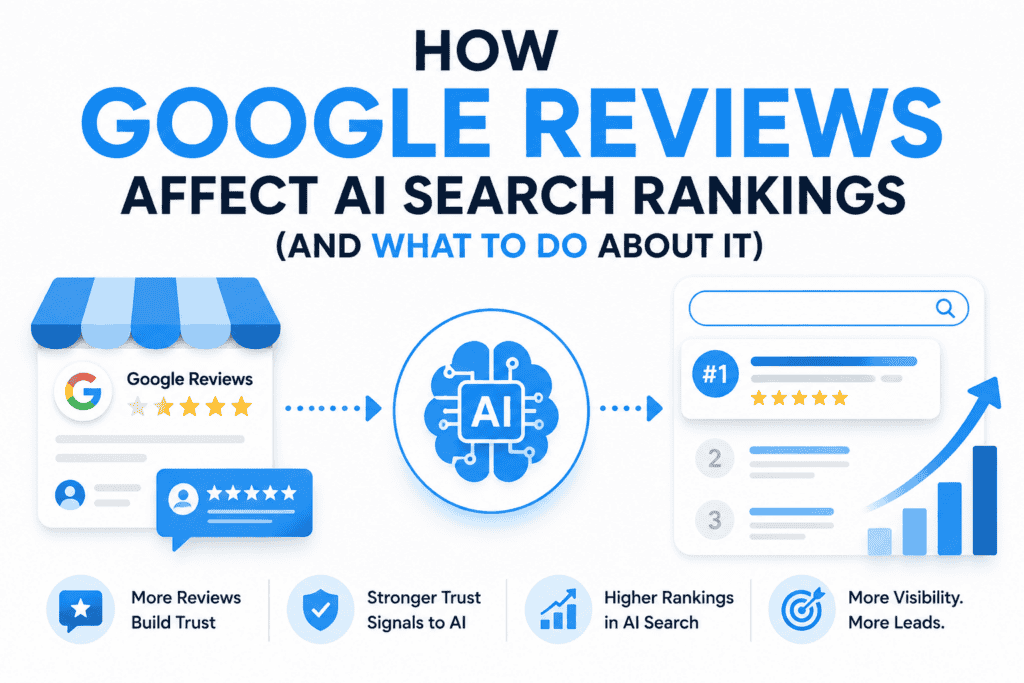
Why Reviews Matter to AI Search Platforms
AI search platforms like ChatGPT, Google’s AI Overviews, and Perplexity are designed to synthesize credible, trustworthy information and deliver a confident recommendation. To do that, they need signals that tell them which businesses are legitimate, established, and well-regarded.
Reviews are one of the clearest, most objective signals available.
Here’s why:
Volume signals legitimacy. A business with 200 reviews has a demonstrably longer history of serving customers than a business with 12 reviews. AI platforms interpret review volume as a proxy for experience and reliability.
Language signals relevance. When AI processes a search for “emergency HVAC repair,” it looks for businesses whose reviews use phrases like “same-day service,” “responded quickly,” or “fixed the problem fast.” The words your customers use in reviews are essentially the keywords AI uses to match your business to relevant searches.
Recency signals activity. Reviews from three years ago tell AI you were active in the past. Reviews from last month tell AI you’re active right now. Recency matters — businesses with a consistent stream of new reviews perform better than businesses with an old review base and nothing recent.
Responses signal professionalism. Businesses that respond to reviews — especially negative ones — demonstrate engagement, accountability, and customer care. AI systems factor this in as a signal of business quality.
The Language in Your Reviews Is Your AI Keyword Strategy
This is the part most businesses miss entirely.
Traditional SEO is built around keywords you control — the words you put on your website, in your meta tags, in your content. AI search adds a new dimension: the keywords your customers choose when they write about you.
When a customer writes “They came out the same day, fixed the leak in under an hour, and cleaned up completely,” that review is doing something important. It’s telling AI that your business:
- Offers same-day service
- Handles leak repairs
- Is fast and efficient
- Is clean and professional
Every one of those phrases can trigger a recommendation when a customer searches for those qualities.
Now multiply that across 200 reviews. The aggregate language across your review base creates a detailed picture of what your business offers and how it performs — far more specific and credible than anything you’d put on your own website.
The businesses that understand this coach their customers on what to include in reviews. Not in a manipulative way — just by naturally mentioning what made the experience good. “Feel free to share what you appreciated most about the service” produces much richer, more specific reviews than “Leave us a review on Google.”
How Many Reviews Do You Actually Need?
There’s no universal threshold, but here’s a practical framework based on competitive market data:
Under 25 reviews: You are essentially invisible in AI search. There isn’t enough data for AI to have confidence recommending you. Priority is generating volume as quickly as possible.
25–75 reviews: You’re building credibility but still behind most active competitors. AI may occasionally recommend you but won’t treat you as a primary choice.
75–150 reviews: You’re competitive. AI has enough signal to recommend you reliably in relevant searches. Focus shifts to maintaining recency and quality.
150+ reviews: You’re in a strong position. Your review base is robust enough to influence AI recommendations consistently, provided you continue generating new reviews to maintain recency.
In competitive markets — large cities, high-demand trades — those thresholds shift upward. An HVAC company in a competitive market may need 300+ reviews to be a top AI recommendation.
The gap between where you are and where you need to be is the opportunity.
How to Build a Review Generation System
Generating reviews at scale requires a systematic approach. The businesses winning at this aren’t manually asking every customer for a review and hoping — they have a process that runs automatically.
Step 1: Identify Your Best Moments to Ask
The best time to request a review is immediately after a completed job when satisfaction is highest. Not a week later. Not in a monthly email blast. Right after the technician leaves or the project is finished.
Timing is the single most important factor in review request success rates.
Step 2: Use SMS as Your Primary Request Channel
Email review requests get buried. SMS gets read.
A well-crafted SMS review request sent within 24 hours of job completion consistently outperforms email by 3–5x in response rates. The message should be short, personal, and include a direct link to your Google review page.
Example: “Hi [Name] — glad we could help with [service]! If you have 60 seconds, a quick Google review helps us a lot: [link]. Appreciate it.”
Step 3: Make It Effortless
The higher the friction, the fewer reviews you’ll get. Your review link should go directly to the review submission page — not your Google Business Profile homepage where customers have to click around to find the review button.
Remove every possible barrier between the customer and the completed review.
Step 4: Automate the Request and Follow-Up
Manual review requests are inconsistent. The technician has a long day, forgets to ask, and the opportunity passes.
An automated system that triggers a review request based on job completion — integrated with your CRM or scheduling software — ensures 100% of completed jobs get a review request every time.
A follow-up message 3–4 days later for customers who didn’t respond recovers additional reviews without being intrusive.
Step 5: Respond to Every Review
Set a process to respond to every review within 48 hours. For positive reviews, thank the customer and reference the specific service. For negative reviews, respond professionally, acknowledge the issue, and offer to make it right.
Your responses are public. AI reads them. Potential customers read them. A business that responds thoughtfully to a negative review often builds more trust than one with a spotless — but unresponsive — review history.
What to Do When You Have Negative Reviews
Negative reviews are a normal part of running a business. What matters is how you handle them.
Don’t panic. A handful of 3-star reviews in a sea of 5-star reviews doesn’t significantly damage your AI ranking or your reputation. Authenticity matters — a business with 200 reviews averaging 4.7 stars is more credible than one with 30 reviews averaging 4.9 stars.
Don’t ignore them. Unanswered negative reviews signal to AI and potential customers that you don’t care. Always respond.
Don’t argue. Even if the review is unfair, a defensive or combative response is more damaging than the original review. Keep it professional, express regret, and offer to resolve it offline.
Do drown them out. The best response to negative reviews is generating significantly more positive ones. A consistent review generation system ensures negative reviews become a small percentage of your total — not a defining feature.
Reviews Across Platforms: Where to Focus
Google reviews should be your primary focus for local business AI visibility. Google’s AI systems have the deepest integration with Google Business Profile data, and Google Reviews are the most widely read by consumers.
But AI platforms also pull from other sources:
Yelp — significant for certain industries (restaurants, home services) and pulled by some AI platforms
Facebook Reviews — relevant for community-facing businesses
Industry-specific platforms — Angi, HomeAdvisor, Houzz (home services), Healthgrades and Zocdoc (medical), Avvo (legal)
BBB — trust signal for AI, especially for service businesses
Your Google Business Profile should be your primary investment. After that, focus on the platforms most relevant to your industry.
Integrating Reviews Into Your Broader AI Search Strategy
Reviews are one piece of the AI search optimization puzzle — but an essential piece. They work alongside:
- Website content structured to answer customer questions
- Consistent business information across all directories
- Active Google Business Profile with regular posts, photos, and updated information
- Local content and mentions that build authority in your market
A business with 300 excellent reviews and a poorly structured website with inconsistent citations will still underperform against a competitor with fewer reviews but a complete, well-optimized online presence.
AI search optimization is a system. Reviews are one of its most powerful components.
The Competitive Window Is Open Now
Most local businesses still think about reviews primarily as social proof for potential customers browsing their profile. That’s still true — but it’s now the smaller part of the value.
The larger opportunity is AI recommendation. And the businesses building their review volume and quality today are establishing an AI ranking advantage that will compound over the next 2–3 years as AI search becomes the dominant way people find local services.
The window to build this advantage before it becomes conventional wisdom — and before your competitors catch on — is right now.
Want to see how your review profile compares to competitors in AI search?
Get your free AI visibility report at lionbear.ai/visibility-report — we’ll show you exactly how your business appears in AI search and where the gaps are.