
 Search Engine Optimization
 Google Maps Ranking
 Google Ads
 Meta Ads
 SEO Websites
 AI Websites
 AI Blog
 AI Guides
 Chiropractors
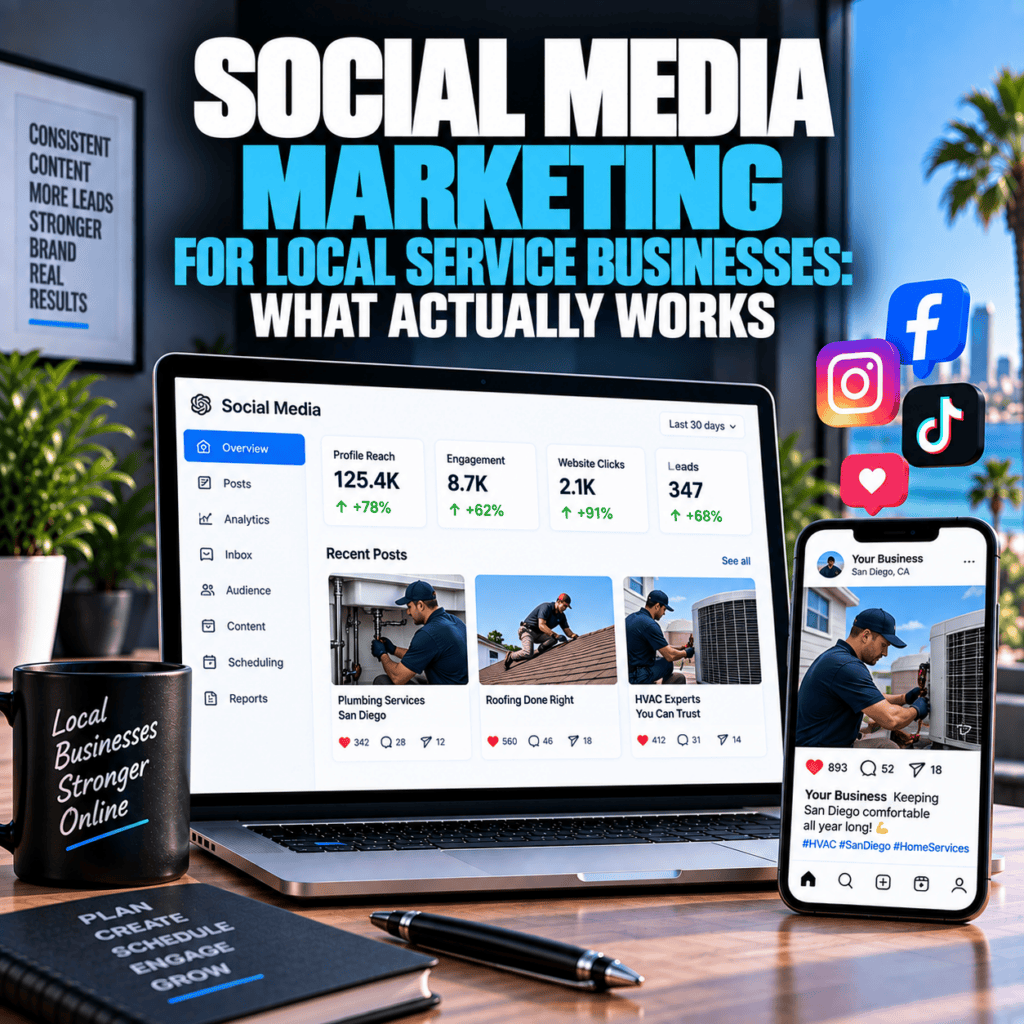
Social Media Marketing for Local Service Businesses: What Actually Works in 2027
Let’s be direct about something most marketing agencies won’t say: for most local service businesses, social media isn’t your highest-ROI marketing channel. SEO, Google Maps ranking, and paid search almost always generate better direct returns per dollar.
That said, social media done right serves a critical function that no other channel replicates: it builds the human trust and brand familiarity that turns a cold lead into a booked job. In a world where customers research businesses before calling, social media is often the deciding factor between two otherwise equal options.
The businesses that show up as real, visible, active companies on social media close more leads than businesses that are invisible. That’s the business case — and it’s a real one.
This guide covers what social media marketing for local service businesses actually looks like when it’s working — including content strategy, platform priorities, the role of video, and how social media connects to the broader AI marketing system.
What Social Media Actually Does for Local Service Businesses
Before diving into tactics, it’s worth being clear about what social media accomplishes — and what it doesn’t.
What It Does
- Builds brand credibility and trust: When a lead from Google Ads or organic search checks you out, your social media presence (or absence) directly affects whether they call. Active, professional, personality-driven social content converts fence-sitters.
- Humanizes the brand: In an industry where trust is everything, showing the real people behind the business — the owner on camera, the team on the job, before-and-after results — builds connection that polished marketing copy can’t replicate.
- Generates referral traffic: Especially on Facebook and Nextdoor, recommendations in community groups drive qualified, warm leads that convert at high rates.
- Contributes to AI entity building: Social media activity, mentions, and engagement contribute to the broader web presence that AI systems reference when building entity profiles. Active social channels are a supporting signal for Generative Engine Optimization.
- Feeds paid social audiences: Engagement data from organic social content improves audience targeting for Meta Ads, creating better performance at lower cost.
What It Doesn’t Do
- Consistently generate emergency service leads on its own (that’s search)
- Replace a strong SEO or Google Ads strategy
- Produce reliable, predictable lead flow without paid amplification
Understanding what social media does and doesn’t do is how you build the right expectations and resource allocation. It’s a support channel with real value — not a replacement for search-based lead generation.
Platform Strategy: Where to Focus
Facebook and Instagram (Priority 1)
For local service businesses, Facebook and Instagram are the primary social platforms. Facebook is where homeowners discuss and recommend services in neighborhood groups. Instagram is where you showcase work quality visually. Meta’s ad platform — which runs across both — is one of the most powerful targeting tools available for offer-based lead generation campaigns.
Our content cadence for Facebook and Instagram: 5 posts per week, mixing educational content, job showcases, team personality, and offer posts at an 80/20 value-to-offer ratio.
YouTube (Priority 2)
YouTube is the most powerful long-term social media investment for local service businesses. Educational video content on YouTube has a much longer shelf life than Instagram or Facebook posts — a well-optimized YouTube video can generate views and leads for years. It also builds the deepest credibility of any platform when you show your expertise on camera.
Our recommended YouTube cadence: 3 videos per month minimum, focusing on educational content that answers common customer questions. This content also feeds AI search optimization — YouTube is a Google property and its content is heavily referenced in AI-generated answers.
LinkedIn (Priority 3 for B2B-Adjacent Services)
LinkedIn is relevant for businesses that serve other businesses — commercial contractors, commercial HVAC, law firms, solar companies with commercial clients — and for building referral relationships with other professionals. For purely residential consumer services, LinkedIn is a lower priority than Facebook and YouTube.
Our LinkedIn cadence: 4–5 posts per week for businesses where B2B relationships matter, focusing on authority, industry insights, and expertise demonstration.
Nextdoor (Underrated Opportunity)
Nextdoor is frequently overlooked by marketing agencies and it shouldn’t be. It’s a neighborhood-based social network where homeowners actively ask for and give business recommendations. A local service business with an active Nextdoor presence — claiming your business page, responding to recommendations, offering neighborhood-specific value — can generate warm, high-trust leads that convert at exceptionally high rates.
The Content Framework That Works for Service Businesses
The 80/20 Rule
80% of your content should provide value. 20% should directly promote your services. This ratio is critical. A social media feed that’s 80% sales pitches gets unfollowed. A feed that consistently educates, entertains, and builds trust gets engagement — and that engagement converts when it’s time to make a hire decision.
The Three Weekly Content Types
At LionBear.ai, we recommend a three-type content rhythm for service businesses:
- Tuesday — Educational: Teach something useful. “3 signs your water heater needs to be replaced.” “What to do when your AC stops working.” “How to prevent roof damage before storm season.” This content builds authority and earns shares in community groups.
- Thursday — Reality Check: Polarizing, honest takes that get people nodding in agreement. “Most business websites are useless and here’s why.” “Responding to a lead tomorrow is the same as not responding.” “Your cheap competitor isn’t doing you any favors.” This content generates engagement and conversation.
- Saturday — Offer: Direct promotion of your services, offers, and availability. “We have 3 spots available this week for AC tune-ups.” “Get your free AI website — we’re taking applications.” “Call us today and get $50 off your first service.” This is where direct conversion happens.
Video First
Every major platform — Instagram, Facebook, YouTube, LinkedIn — deprioritizes static images and text posts in favor of video. The algorithm rewards video because users engage with it more. If you’re not creating video content, you’re operating at a disadvantage.
The good news: you don’t need a production studio. The most effective social media videos for local service businesses are filmed on a phone, direct to camera, in a natural setting. Bjorn built LionBear.ai’s entire content presence this way — real, direct, personality-driven video that feels human rather than produced.
Our video scripts in the LionBear.ai content strategy cover exactly this: short-form video (60–90 seconds), direct to camera, vertically filmed, covering educational topics, industry insights, and offer-based content.
Social Media and the Full Marketing System
Social media works best as part of a complete system — not as a standalone effort. At LionBear.ai, organic social media content feeds:
- Retargeting audiences for Meta Ads — people who engaged with your organic content are warmer prospects for paid offers
- Brand search activity — when someone sees your video and later Googles your business name, that branded search confirms to Google that your brand has real-world recognition, supporting SEO
- AI entity building — social media activity and mentions contribute to the broader web presence that Answer Engine Optimization builds on
- Lead flow — social media leads that enter through direct messages or link clicks flow into the same AI Employee follow-up system as any other lead
Social Media by Industry
Different industries benefit from different social media approaches:
- HVAC: Before-and-after installs, energy savings tips, seasonal prep content, emergency availability posts
- Roofing: Storm response content, project galleries, insurance claim guidance, material education
- Solar: Bill savings testimonials, installation showcases, incentive updates, environmental impact content
- Law firms: Case type education (without case specifics), legal rights awareness, community involvement
- Dentists: Before-and-after smile transformations, oral health education, new patient offers, staff introductions
- Chiropractors: Pain relief tips, posture education, patient testimonials, wellness content
- Pest control: Prevention tips, identification guides, seasonal pest warnings, before-and-after content
Getting Social Media Working for Your Business
Social media marketing is one component of the complete LionBear System — alongside AI search visibility, Google Maps ranking, automated lead response, and paid traffic. Each channel supports the others. Together, they build the kind of dominant local market presence that generates consistent, predictable revenue growth.
Start with a free AI Visibility Report to see where your current online presence stands — social media, Google, AI search — and where the biggest opportunities are. Then talk to the LionBear.ai team about building a social media strategy that works as part of a complete revenue system, not just a content calendar.
Your competitors are posting. The question is whether what they’re posting is actually building their business — or just keeping them busy. Done right, social media builds lasting brand authority that compounds alongside your AI visibility and turns your marketing into a flywheel that runs on its own.