
What Is Generative Engine Optimization (GEO) — And Why It’s Replacing Traditional SEO
For two decades, SEO meant one thing: rank on page one of Google.
Businesses hired agencies, built backlinks, optimized keywords, and competed for the top three organic positions. The formula was well understood. The rules were consistent. The game was predictable.
That game is changing — faster than most business owners realize.
A new discipline is emerging called Generative Engine Optimization, or GEO. It’s the practice of optimizing your business’s online presence to be cited and recommended in AI-generated answers — not just ranked in traditional search results.
Understanding GEO isn’t optional for local businesses anymore. It’s the difference between being the business AI recommends and being invisible to a growing segment of customers who never scroll past the AI answer at the top of the page.
What Is Generative Engine Optimization?
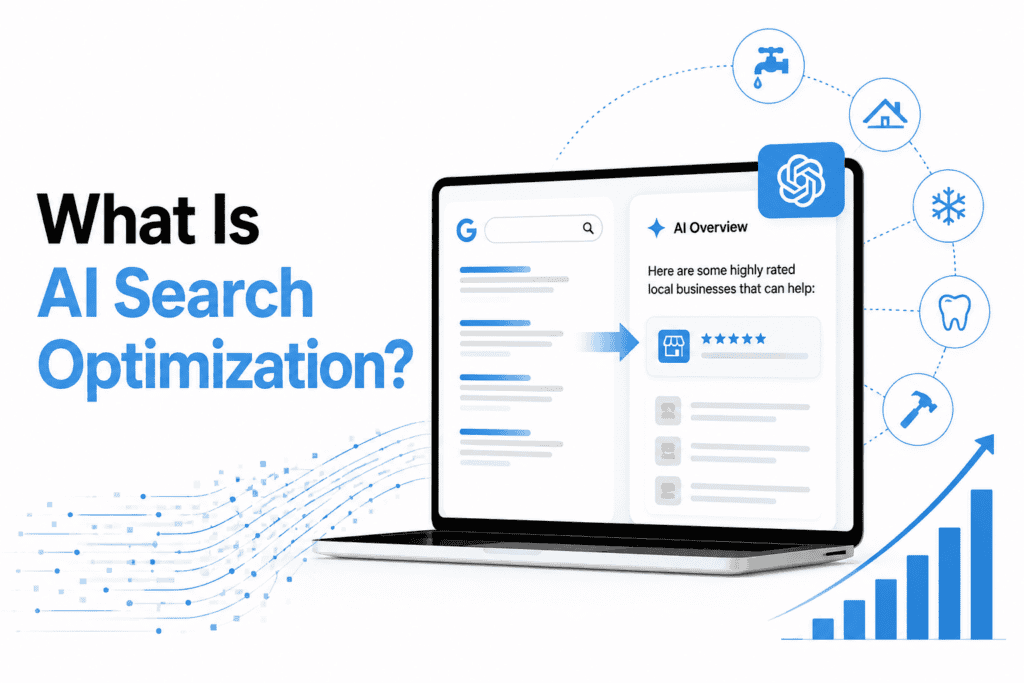
Generative Engine Optimization (GEO) is the process of structuring your content, online presence, and authority signals so that AI-powered search engines — ChatGPT, Google’s AI Overviews, Perplexity, Bing Copilot, and others — include your business in their generated responses.
When someone asks an AI “Who’s the best roofer in my area?” the AI doesn’t return a list of links. It generates a direct, confident answer — a recommendation, sometimes with supporting details about why that business is trustworthy.
GEO is how you become that recommendation.
It’s closely related to other terms you may have heard — Answer Search Optimization (ASO), AI Search Optimization, or AI SEO. These all describe the same fundamental shift: optimizing for AI-generated answers rather than traditional ranked results.
How GEO Differs From Traditional SEO
Traditional SEO and GEO overlap in some areas — both value authoritative content, consistent business information, and strong backlink profiles. But the core logic is different.
With traditional SEO, the goal is a ranked link in a list of results. The consumer chooses from multiple options. With GEO, the goal is to be the answer. The AI generates a single recommendation and the consumer acts on it.
With traditional SEO, the primary signals are backlinks, keywords, and technical structure. With GEO, the primary signals are reviews, content authority, citations, and entity clarity.
With traditional SEO, you compete for position. With GEO, you compete to be chosen by AI before the customer ever sees a list.
Why Generative Engines Are Changing Search Behavior
The shift to AI-generated answers isn’t a gradual trend — it’s accelerating across multiple platforms simultaneously.
Google AI Overviews now appear at the top of a growing percentage of search queries, above all organic results and above ads. For many local service searches, the AI Overview is the first and only result many users engage with.
ChatGPT has over 200 million monthly active users and is increasingly used for local recommendations — finding contractors, comparing service providers, deciding who to call for a specific problem.
Perplexity is growing rapidly as an AI-native search engine that generates answers with citations, bypassing traditional search results entirely.
Each of these platforms makes the same fundamental trade: instead of showing users a list of options, they synthesize available information and deliver a direct answer. For local businesses, this means being on page one is no longer sufficient. You need to be the answer.
How Generative Engines Decide What to Recommend
Entity Clarity
AI systems need to clearly understand what your business is, what it does, who it serves, and where it operates. Businesses with clear, consistent entity information across their website, Google Business Profile, and third-party directories are far easier for AI to understand — and therefore recommend. Inconsistencies create entity confusion, and entity confusion reduces AI recommendation frequency.
Topical Authority
AI favors businesses that demonstrate deep expertise in a specific domain. A plumbing company with detailed content about pipe repair, water heater installation, drain cleaning, and emergency services signals topical authority in plumbing — far more than a company with a single generic Services page. The more thoroughly your online presence covers your area of expertise, the more confidently AI can recommend you.
Review Signals
Review volume, recency, and the specific language customers use in reviews are among the strongest GEO signals available. AI systems interpret a robust, recent review profile as evidence that a business is actively serving customers and doing so well.
Citation and Mention Volume
How many credible sources mention your business? Local news coverage, industry publications, community websites, and directories all contribute to the authority AI assigns to your business. This is the GEO equivalent of traditional backlinks — but broader in scope.
Content Structure
Content structured in natural, question-and-answer format — the way people actually speak when asking AI — is easier for generative engines to extract and cite. Structured data (schema markup) helps AI systems understand the specific attributes of your business: service areas, operating hours, specialties, and credentials.
The 5 Core GEO Strategies for Local Businesses
1. Build a Clear Entity Profile
Ensure your business is described consistently and completely everywhere it appears online. Your name, address, phone number, service categories, and service area should be identical across your website, Google Business Profile, Yelp, Facebook, and every directory where you’re listed.
2. Create Question-Based Content
Map out the questions your customers ask — not just the keywords they search. Then build content that answers those questions directly and thoroughly. “How long does a roof replacement take?” “What’s included in an HVAC tune-up?” “How do I know if I have a plumbing emergency?” These questions, answered with genuine expertise, position your business as the authoritative source AI pulls from.
3. Aggressively Build Review Volume
Reviews are one of the highest-leverage GEO activities available to a local business. A systematic review generation process — automated requests after every completed job, with follow-up for non-responders — builds the review base that AI relies on to evaluate your business. Focus on Google first, then expand to industry-relevant platforms.
4. Earn Citations and Mentions
Get your business mentioned in credible local and industry contexts. Local press coverage, guest posts on industry blogs, community sponsorships, and participation in local business directories all contribute to citation authority. Quality matters more than quantity — a mention in a local news article carries significantly more weight than a listing in a low-authority directory.
5. Implement Structured Data
Schema markup communicates your business information directly to AI systems in machine-readable format. At minimum, local businesses should implement LocalBusiness schema with complete information about services, location, hours, and contact details. Review schema, FAQ schema, and Service schema each add additional layers of AI-readable structure.
The Competitive Window Is Open Now
Most local businesses haven’t heard of GEO. The ones that have heard of it haven’t acted on it yet. That gap is the opportunity.
The businesses building their GEO presence today — creating structured content, generating reviews systematically, building citation authority, implementing schema — are establishing positions that will compound in value as AI search grows.
Early movers in traditional SEO owned their markets for years before competitors caught up. The same dynamic is playing out in GEO right now, just compressed into a shorter window because the shift is happening faster.
Want to see how your business currently appears in AI search? Get your free AI visibility report — we’ll show you exactly where you stand and where your competitors are showing up instead. Or if you’re ready to talk, book a free demo and we’ll walk you through exactly what GEO looks like for your business.