
Why Local Businesses Lose Leads (And the Automated Follow-Up System That Fixes It)
Introduction
You’re not losing customers because of your service. You’re losing them because of what happens — or doesn’t happen — after they reach out.
A lead submits a form on your website at 8:14 PM on a Tuesday. No one responds until Wednesday morning. By then, they’ve already booked with the first business that got back to them.
This happens hundreds of times a year for the average local business. It’s not dramatic. There’s no single moment where you see the revenue walk out the door. But the loss is real, and it compounds.
A Harvard Business Review study found that responding to a lead within 5 minutes makes you 100 times more likely to close than responding within 30 minutes. Most local businesses are responding in hours — or not at all.
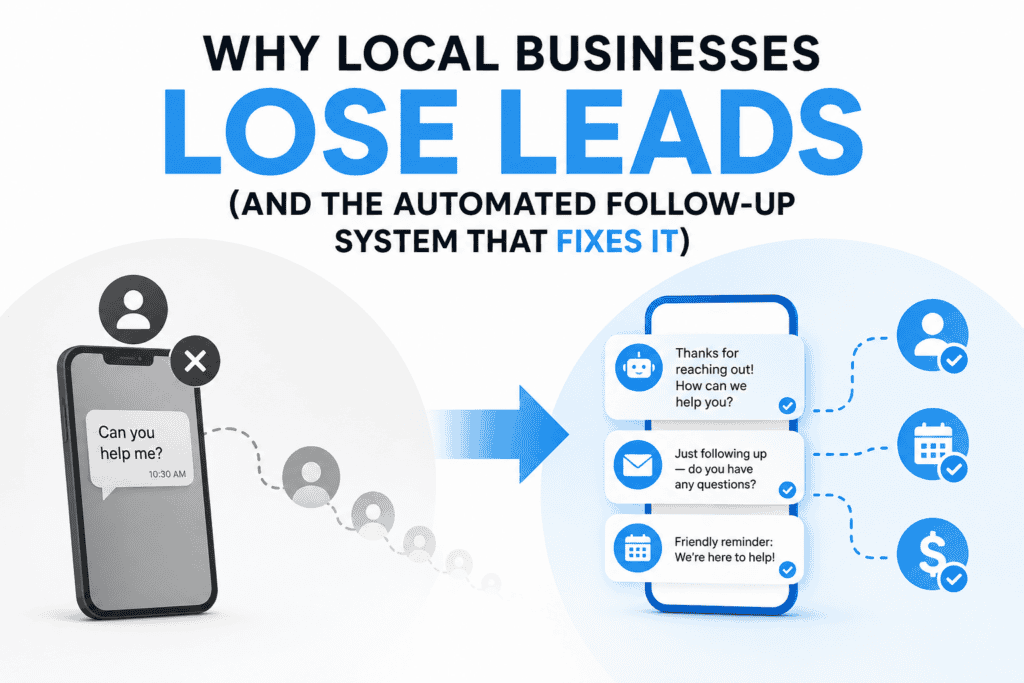
The fix isn’t hiring more staff. It’s building an automated lead follow-up system that responds instantly, every time, no matter when the lead comes in.
The Lead Loss Problem Most Business Owners Don’t See
Here’s why this problem is so persistent: it’s invisible.
When a lead reaches out and doesn’t get a fast response, they don’t call you back and tell you they went somewhere else. They just disappear. The inquiry goes unanswered. The job gets booked with a competitor. You never know it happened.
This is the silent revenue leak inside almost every local service business. The leads are coming in — from your website, Google, social media, referrals — but a significant percentage are slipping through before anyone has a chance to engage them.
The businesses that solve this problem build a measurable competitive advantage. They close more jobs, book more appointments, and fill their calendar more consistently — not because they’re generating more leads, but because they’re capturing a higher percentage of the leads they already have.
Why Speed Is the Single Most Important Follow-Up Factor
Speed to respond is the most undervalued variable in local business marketing.
When a customer reaches out for a plumber, HVAC technician, or roofer, they’re often dealing with an urgent situation. A broken pipe. A furnace that stopped working. Storm damage. They’re not browsing — they’re ready to book.
In that moment, the first business that responds wins the job. Not the cheapest. Not the most experienced. The fastest.
This is supported by research. The Harvard Business Review data is stark: lead contact rates drop dramatically within the first few minutes of a lead coming in. After 30 minutes, your odds of reaching that lead drop by 21 times compared to the first 5 minutes.
By the time a team member finds the inquiry in their email inbox the next morning, that lead has moved on.
What a Lead Follow-Up Gap Actually Costs
To understand the real cost, let’s do the math for a typical home service business.
Assume your business generates 60 inbound leads per month across all channels — website forms, Google calls, social media, and referrals. Industry data suggests that 20–30% of those leads go uncontacted or receive a response too slow to convert.
That’s 12–18 leads per month that slip through.
If your average job value is $800, and you close at even a modest 30% rate on those recovered leads, that’s an additional $2,880 to $4,320 per month — just from fixing your response speed.
That’s $34,000 to $52,000 per year in recoverable revenue from a system problem, not a marketing problem.
What Automated Lead Follow-Up Looks Like
An automated lead follow-up system intercepts every new lead the moment it comes in and initiates contact before a human has to do anything.
Here’s how a properly built system works:
Step 1: Instant SMS Response (Within 60 Seconds)
The moment a lead fills out your website form or submits an inquiry, they receive an automated SMS text message. Not an hour later. Within 60 seconds.
The message is conversational and personal — not robotic. Something like:
“Hey [Name] — thanks for reaching out! This is [Business Name]. We got your request and we’re on it. Is now a good time for a quick call, or would you prefer we text back and forth?”
This immediately differentiates you from every competitor who hasn’t responded yet. The lead feels acknowledged. The conversation is open.
Step 2: Intelligent Follow-Up Sequence
If the lead doesn’t respond to the first message, the system continues following up — at thoughtful intervals — without you doing anything.
Day 1: Initial response
Day 2: Check-in with value
Day 4: Social proof or offer
Day 7: Re-engagement
Each message is designed to restart the conversation, not pitch aggressively. The goal is to keep the door open until the lead is ready.
Step 3: Email Nurture (For Leads Who Need More Warming)
Some leads aren’t ready to book immediately. They’re comparing options, waiting to see if the problem resolves itself, or just in research mode.
An email nurture sequence keeps your business top of mind while they make their decision. Educational content, social proof, and gentle reminders keep you in the conversation over days and weeks.
Step 4: Human Handoff
When a lead responds — whether to the SMS or email — the system flags them and notifies your team for a real human conversation. By the time your team engages, the lead is warm, the conversation has started, and the booking process is well underway.
The Difference Between Manual Follow-Up and Automated Follow-Up
Most businesses rely on a manual follow-up process — someone checks the inbox, sees the lead, and responds when they get to it. Here’s how that compares to an automated system:
| Manual Follow-Up | Automated Follow-Up | |
|---|---|---|
| Response Time | Hours to days | Under 60 seconds |
| Consistency | Depends on who’s working | 100% consistent, 24/7 |
| After-Hours Leads | No response until next day | Immediate response, always |
| Follow-Up Depth | 1–2 attempts typically | 5–7 touchpoints across SMS + email |
| Team Bandwidth | Requires staff time | Runs automatically |
| Revenue Impact | Leaks 20–30% of leads | Captures significantly more |
The automation doesn’t replace your team. It handles the first response and follow-up so your team spends their time on conversations that are already warm — not cold leads who haven’t heard from you yet.
Common Objections — And Why They Don’t Hold Up
“Our customers prefer calls.”
Maybe. But they’re not going to sit by the phone waiting for you to call back. An instant text confirms you received their request and keeps the conversation alive until you can call. It’s additive, not a replacement.
“We already follow up pretty quickly.”
“Pretty quickly” is relative. If your average response time is 2–4 hours, you’re losing a meaningful percentage of your leads to competitors who respond in minutes. Speed isn’t a nice-to-have — it’s the deciding factor.
“We don’t have the volume to justify automation.”
Automation pays for itself when it saves you even one or two jobs per month. For most home service businesses, a single recovered job covers the cost of a complete marketing system for months.
“Won’t it feel impersonal?”
Only if it’s written that way. A well-crafted automated message is conversational, warm, and personal. Most leads don’t realize they’re receiving an automated response — and once the conversation starts, your team takes over.
The Role of AI in Lead Follow-Up
Modern lead follow-up systems go beyond scripted text sequences. AI allows the system to:
- Understand intent from lead inquiries — if a lead mentions a specific problem in their form submission, the follow-up can reference it directly
- Adjust messaging based on behavior — if a lead opens emails but doesn’t respond, the system can shift strategy
- Suggest optimal send times based on engagement patterns
- Flag high-priority leads so your team knows who to call first
This moves follow-up from a static sequence to an intelligent system that learns and improves over time.
Building a Follow-Up System That Works for Your Business
An effective automated follow-up system for a local service business includes:
- Immediate SMS acknowledgment — personalized, conversational, within 60 seconds of inquiry
- Multi-day SMS sequence — 5–7 touches over 7–14 days with value-driven messaging
- Email nurture sequence — for leads who provided an email, a parallel education-based sequence
- Pipeline tracking — visibility into where every lead stands in your follow-up process
- Team notification — alerts when a lead responds so no hot conversation goes unattended
- Reactivation campaigns — periodic outreach to leads who went cold but didn’t formally say no
All of this should run inside a CRM that gives you full visibility into your lead pipeline — not scattered across email inboxes and paper notepads.
What This Looks Like for a Real Business
Take a roofing company running paid ads. Before implementing an automated follow-up system, leads came in through the website form, got added to a spreadsheet, and someone called them the next morning. Conversion rate: 18%.
After implementing automated follow-up — instant SMS, a 7-day sequence, and a parallel email nurture — the same ad spend generated the same volume of leads. But response rate to the first message went from 12% to 34%. Booked calls increased. Conversion climbed to 27%.
Same leads. Better system. Measurably more revenue.
The Bottom Line
Lead generation is one part of the equation. But generation without capture is expensive and inefficient.
The businesses consistently filling their calendars aren’t necessarily spending more on ads. They’ve built a system that captures every lead at the moment of interest — and follows up intelligently until that lead books or disqualifies themselves.
Speed wins. Consistency wins. Automation is how you achieve both without burning out your team.
Ready to stop losing leads you’ve already paid to generate?
Get your free AI visibility report at lionbear.ai/visibility-report — or book a free demo at lionbear.ai/book to see exactly how an automated follow-up system would work for your business.