
 Search Engine Optimization
 Google Maps Ranking
 Google Ads
 Meta Ads
 SEO Websites
 AI Websites
 AI Blog
 AI Guides
 Chiropractors
Why the First 5 Minutes After a Lead Comes In Are Worth More Than Your Entire Marketing Budget
There’s a piece of research from Harvard Business Review that should change the way every local business thinks about their follow-up process.
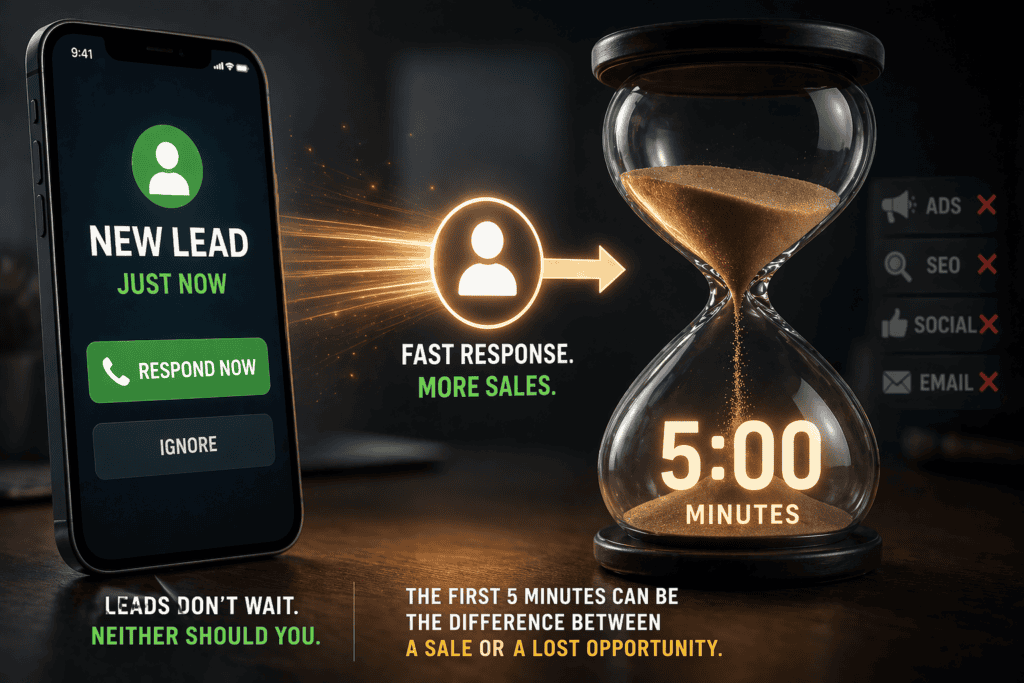
The study looked at the relationship between response time and lead conversion. What they found was this: companies that responded to leads within five minutes were dramatically more likely to close them than companies that waited longer.
Not a little more likely. Dramatically more.
The research showed that the odds of converting a lead dropped sharply after the first five minutes and continued declining the longer the response was delayed. By the time a lead had gone unanswered for thirty minutes, the conversion probability had fallen to a fraction of what it was in that initial window.
For local service businesses — where leads are often high-value and the customer is usually comparing multiple options simultaneously — this data is not abstract. It’s dollars.
Why the First Five Minutes Matter So Much
Think about what’s actually happening when someone submits a form or calls your business:
They have a problem. It might be urgent — a leaking pipe, an AC unit that stopped working in the middle of summer, a roof damaged in a storm. Or it might be a planned project they’ve been putting off, and today they finally decided to act.
Either way, in that moment, they are ready. The motivation to move forward is at its peak. They’ve already done some research, they’ve found you, and they’ve made the decision to reach out. That decision took effort.
Now they’re waiting.
If you respond in five minutes, you catch them while the motivation is still fresh, while they’re still thinking about the problem, while they haven’t yet gotten distracted by the rest of their day.
If you respond in two hours, they’ve already called two other businesses. One of them already booked the job.
If you respond the next day — if you respond at all — the job is done. Someone else did it.
The cruel irony is that the business owner who responds slowly isn’t negligent. They’re just busy. They’re doing the actual work. They can’t stop what they’re doing every time a form comes in.
Which is exactly why the follow-up can’t depend on a human being available.
The Problem With Manual Follow-Up
Most local businesses follow up manually. The lead comes in by email or text. Someone on the team — or the owner themselves — has to see it, find time to respond, and send a message or make a call.
In theory, this works fine. In practice, it breaks down constantly.
Job sites don’t have great cell service. People are in crawl spaces, on rooftops, in attic spaces. Back-office staff handle multiple things at once. The owner is in a meeting or on a job or picking up kids.
Leads come in at inconvenient times — evenings, weekends, early mornings. The form submission from 9pm on a Friday sits in an inbox until Monday morning.
Every one of those gaps is a lost opportunity. Not hypothetically — concretely. The customer moved on.
What AI-Powered Follow-Up Changes
Automation doesn’t replace the human relationship. It preserves the opportunity until the human can engage.
Here’s how it works in practice:
A lead submits a form on your website at 8pm on a Thursday. Within 60 seconds, they receive a text message:
“Hey [first name], thanks for reaching out — I got your message and I’ll be following up with you shortly to go over [service type]. What’s the best time to connect?”
It’s not robotic. It’s conversational. It arrives instantly. The lead feels seen and responded to, even though no human has done anything yet.
That message alone changes the trajectory of the lead. Instead of moving on to the next business, they respond. They engage. They wait for the call because they know someone is coming.
By the time you or your team actually follows up, the lead is warm. They’re expecting you. The job is half yours already.
Compare that to responding the next morning with no prior contact. The lead has already talked to two other companies. They might give you a shot if neither of the others called back — but the advantage is gone.
The Missed Call Is the Most Expensive Problem
The most common version of this failure isn’t even a form submission that goes unanswered. It’s a phone call.
Someone finds your business, decides to call, gets voicemail, hangs up, and calls the next result on Google.
Done. That lead is gone.
A missed call text-back system changes this outcome. The moment a call goes unanswered, the caller receives a text: “Hey, sorry we missed your call — we’ll be back with you shortly. What can we help you with?”
This one feature, by itself, recovers a significant percentage of leads that would otherwise be permanently lost. The caller didn’t want to leave a voicemail. But a text back invites a response — and most people will respond to a text.
What This Looks Like at Scale
When these systems run in the background consistently — responding to forms within seconds, texting back missed calls immediately, sending follow-up sequences to leads that don’t respond right away — the math changes.
Consider a business that gets 30 leads per month. Without automation, they convert 30–40% — 9 to 12 jobs. With an automated follow-up system, conversion improves substantially. Even a 10–15% increase in conversion on 30 leads per month means 3–5 additional jobs.
If the average job is worth $1,500, that’s $4,500–$7,500 per month in additional revenue from the same lead volume. The lead flow didn’t change. The close rate did.
That’s what a system does that a manual process can’t.
The Full System
The follow-up automation is one piece of what we build at LionBear.ai. The complete system includes:
- A website that captures leads and converts visitors into submissions
- AI-powered follow-up that responds within seconds, day or night
- Missed call text-back so no phone lead walks out the door
- Automated sequences for leads that don’t respond immediately
- Review request automation so every completed job builds your AI search visibility
- A CRM so you can see your full pipeline, lead flow, and close rate
The goal is simple: make sure no lead that found you ever slips through the cracks.
If you want to see what this looks like for your business specifically — what your current visibility is and where the gaps are — grab your free report. We’ll show you exactly where you stand and what’s available.