
 Search Engine Optimization
 Google Maps Ranking
 Google Ads
 Meta Ads
 Microsoft Ads
 SEO Websites
 AI Websites
 AI Blog
 AI Guides
 Chiropractors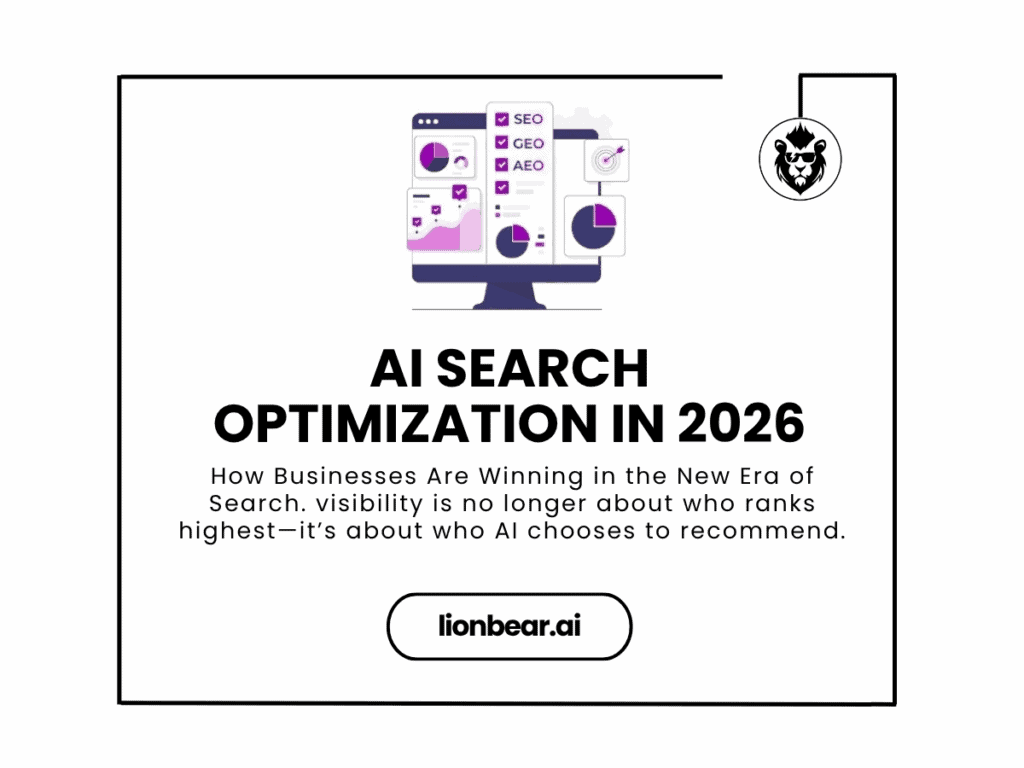
Introduction
The AI search revolution has officially arrived. By the end of 2025, Google’s Search Generative Experience (SGE), ChatGPT’s browsing model, and Gemini’s integration into Chrome reshaped how people discover local businesses. The familiar “page one” of Google has become a dynamic, AI-generated summary.
That means visibility is no longer about who ranks highest—it’s about who AI chooses to recommend.
This new marketing reality demands AI Search Optimization (ASO), the next evolution of SEO. ASO isn’t about chasing clicks; it’s about being cited, referenced, and recommended across generative search systems. Businesses that have adapted are already reaping predictable, compounding visibility—while those relying on old SEO methods are fading into irrelevance.
What Exactly Is AI Search Optimization?
AI Search Optimization (ASO) is the discipline of structuring your digital presence so that AI assistants—ChatGPT, Perplexity, Gemini, Copilot—identify your business as the most credible, contextually relevant answer.
Traditional SEO focused on ranking webpages.
ASO focuses on earning recommendations.
It combines:
- Answer Engine Optimization (AEO): Optimizing for “who should I hire” questions so AI assistants recommend your business.
- Generative Engine Optimization (GEO): Ensuring your brand and content appear inside AI-generated summaries and knowledge panels.
- Entity SEO: Strengthening structured data, brand signals, and topical authority so AI systems “understand” your expertise.
Why Traditional SEO Can’t Compete in 2026
By late 2025, Google AI summaries began replacing organic listings in over 60% of commercial queries. Fewer users click through to websites. Instead, they read AI-compiled overviews that already contain the best answers.
That means the top spot no longer guarantees visibility.
The new winners are those whose data AI trusts enough to quote.
AI engines prioritize:
- Verified business listings
- Schema-rich websites
- Clear service descriptions
- High review consistency
- Authority content backed by expertise
If your digital footprint lacks structured data or clarity, AI can’t recommend you.
How ASO Works: The Core Framework
1. Entity Clarity
AI needs to understand exactly who you are and what you do. That requires consistent naming, NAP data, service pages, and schema markup across all platforms.
2. Conversational Content
Users now ask questions, not keywords. Your website must include natural Q&A formats:
- “What’s the average roof replacement cost in San Diego?”
- “Who offers emergency HVAC repair near me?”
Each of these queries gives AI systems training data that connects your brand to real-world intent.
3. Authority Depth
AI models weigh topical expertise heavily. Websites that include comprehensive educational content—FAQs, comparisons, case studies—are more likely to be cited in generated answers.
4. Multi-Platform Signals
ASO spans Google Business, Yelp, Facebook, and industry directories. Every consistent signal builds trust.
5. Conversion Integration
Visibility only matters if it converts. That’s where the AI Employee (https://lionbear.ai/ai-employee/) comes in—capturing leads and booking appointments automatically once ASO drives new visitors.
Real-World Example: How ASO Increased Booked Jobs by 72%
A home services company in Phoenix implemented a full ASO strategy—structured service pages, AEO-optimized FAQs, and generative content clusters.
Within six months:
- AI-related visibility in ChatGPT and Perplexity increased 112%.
- AI citations inside Google summaries grew from 0 to 9 mentions per week.
- Lead conversion through the AI Employee improved 72%, with 40% of those leads originating from AI-generated queries.
Their organic traffic didn’t double—their trust signal did.
Why 2026 Is the Turning Point
Throughout 2025, early adopters experimented with AEO and GEO. In 2026, ASO becomes the baseline for visibility. Google, Microsoft, and OpenAI are all integrating business recommendation layers powered by structured data and verified expertise.
That means the first movers—businesses that already built AI-optimized websites—will maintain compounding exposure while late adopters must spend significantly more to catch up.
How to Implement AI Search Optimization in 2026
Step 1: Audit Your Digital Identity
Use AI tools and search queries to see how ChatGPT, Gemini, and Google perceive your brand. Note missing or inaccurate information.
Step 2: Rebuild Service Pages for Clarity
Each core service should have its own structured, keyword-rich page written in natural language, with questions, examples, and embedded FAQs.
Step 3: Add Schema and Knowledge Markup
Use LocalBusiness, Service, Review, and FAQ schema. Structured data gives AI the “map” it needs to recognize your expertise.
Step 4: Publish Authority-Based Content
Create educational guides and blogs that answer both commercial and informational questions related to your services. Link them internally to your core pages.
Step 5: Integrate Automation and Lead Follow-Up
Once ASO attracts AI-driven visibility, automation ensures you never miss a lead. The AI Employee qualifies, follows up, and books new customers automatically.
The Role of AI Websites in ASO Success
An AI Website is more than a digital storefront—it’s a structured, machine-readable system designed for AI engines. These websites organize content in a way that allows generative models to extract data accurately.
Features that improve ASO performance include:
- Consistent topic clusters
- Optimized FAQs
- Schema-driven layouts
- Fast, mobile-first design
- Clear local business metadata
When your website becomes AI-ready, you move from being “ranked” to being “recommended.”
Beyond SEO: The New Metrics of Success
By 2026, marketing performance will be measured less by traffic volume and more by visibility inside AI ecosystems. Key metrics include:
- Frequency of brand mentions in AI overviews
- Positioning inside generative summaries
- AI citation count growth
- Conversion velocity via automation
The businesses that dominate these metrics will own the next decade of search.
Conclusion
2026 marks the full shift from search engines to answer engines. Businesses that adapt through AI Search Optimization will not just survive—they will dominate. ASO ensures that your company is visible, cited, and recommended whenever users ask AI for solutions. Combined with an AI Employee and a structured AI Website, it transforms digital marketing into an automated growth system.
Those who move now will control the next wave of visibility. The question is no longer whether AI will change SEO—it already has. The only question is whether your business will adapt in time.
Ready to upgrade from SEO to ASO and dominate AI search in 2026? Book your free strategy call at https://lionbear.ai/book and see how AI Search Optimization can help your business become the next trusted recommendation in AI results.
Learn more about AI Marketing solutions by checking out AI Search Engine Optimization (ASO), AI Websites for Local Businesses, AI Employee, Generative Engine Optimization (GEO), and Answer Engine Optimization (AEO).
Schedule your Free AI Marketing Strategy Call @ lionbear.ai/book