
 Search Engine Optimization
 Google Maps Ranking
 Google Ads
 Meta Ads
 SEO Websites
 AI Websites
 AI Blog
 AI Guides
 Chiropractors
Schema Markup for Local Businesses: What It Is and Why AI Search Needs It
Schema markup sounds technical, and most local business owners have never touched it directly. But it’s one of the most direct ways to communicate exactly what your business is, what it offers, and why it should be trusted — in a format that search engines and AI platforms can read with complete certainty.
Without schema, search engines and AI systems have to infer information about your business by parsing your website’s text, which leaves room for misinterpretation. With schema, that same information is labeled explicitly, removing ambiguity entirely.
As AI search becomes a bigger factor in how customers find local businesses, schema markup has gone from a nice technical detail to a meaningful piece of AI search visibility.
What Schema Markup Actually Is
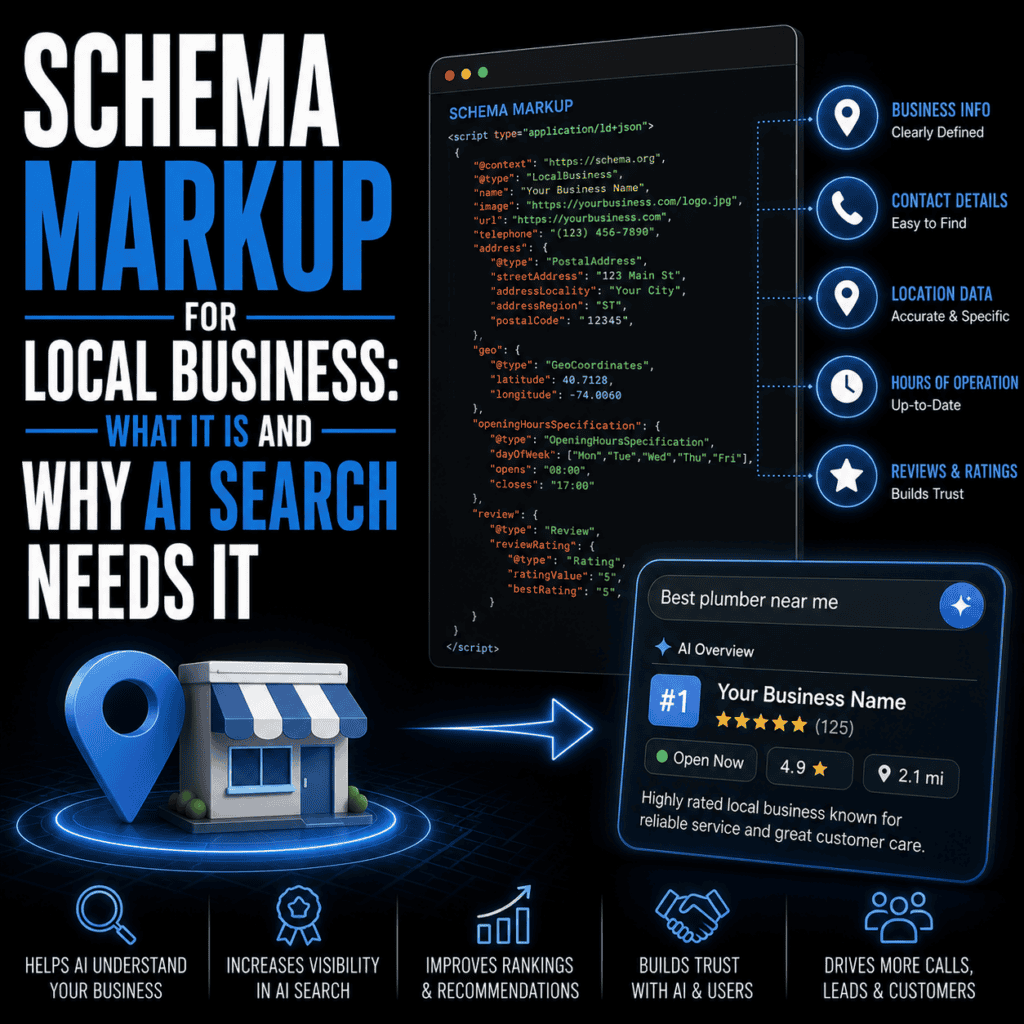
Schema markup is a standardized code structure, typically written in a format called JSON-LD, that’s added to your website’s pages. It labels specific pieces of information — your business name, address, phone number, hours, services, reviews, and more — in a way that search engines and AI systems can parse directly, rather than guessing based on surrounding text.
Think of it as the difference between a search engine reading a paragraph that mentions your hours somewhere in the text, versus being told explicitly: this is the business name, this is the phone number, these are the hours, this is the service offered. Schema removes the guesswork.
Why Schema Matters for AI Search Specifically
AI systems generating recommendations need to quickly and confidently understand what a business offers. Structured data gives them exactly that — clean, labeled information rather than content they have to interpret.
A business with comprehensive schema markup gives AI platforms clear answers to the questions that matter most when generating a recommendation: what type of business is this, what services does it offer, where is it located, what are its hours, what do customers say about it. The more of this information is explicitly structured, the easier it is for AI to confidently include that business in a generated answer. This is how to rank in chatgpt.
The Most Important Schema Types for Local Businesses
LocalBusiness Schema
This is the foundational schema type for any local business. It captures your business name, address, phone number, hours of operation, price range, and service area. Every local business website should have this implemented at minimum, ideally on every page but especially the homepage and contact page.
Service Schema
Service schema labels the specific services your business offers, going beyond what LocalBusiness schema captures. For a plumbing company, this might mean separate Service schema entries for drain cleaning, water heater repair, and emergency plumbing — each clearly labeled with a description, making it easier for AI to match your business to specific service searches.
Review Schema
Review schema structures the reviews and ratings displayed on your website, making your review data explicitly readable rather than just visible as text on the page. This reinforces the same review signals that matter elsewhere in your AI search strategy, this time directly within your site’s code.
FAQ Schema
FAQ schema labels question-and-answer content on your pages, which is particularly valuable for AI search since generative engines often pull directly from clearly structured Q&A content when generating an answer. A well-built FAQ section with proper schema markup is one of the more direct ways to increase the odds of being cited in an AI-generated response.
BreadcrumbList Schema
While less directly tied to AI recommendations, breadcrumb schema helps search engines understand your site’s structure and hierarchy, which contributes to overall site clarity and indexing — a smaller but still relevant piece of the broader picture.
How Schema Markup Gets Implemented
Schema is typically added through a plugin on WordPress sites, such as Rank Math, which can generate much of the standard schema automatically based on your page content and settings. For schema types not automatically covered, custom JSON-LD can be added directly to specific pages through a code injection plugin.
It’s worth noting that most SEO plugins, including Rank Math, allow only one primary schema type to be actively applied per page through the plugin interface itself. Additional schema types beyond that one slot typically need to be added through a separate code injection method to avoid conflicts.
Common Schema Mistakes
Implementing schema that doesn’t match the actual visible content on the page can create inconsistencies that search engines flag as untrustworthy, so schema should always accurately reflect what’s genuinely on the page. Leaving fields incomplete — listing a business name and address but skipping hours, services, or other available fields — reduces the value schema provides. And applying schema once without revisiting it as your business changes means your structured data can become outdated even as your actual hours, services, or offerings evolve.
How Schema Fits Into a Complete AI Search Strategy
Schema markup is one component of a broader system that includes AI search optimization, consistent business citations, and a strong review profile. A site with excellent schema but thin content and few reviews will still underperform a competitor with a complete, well-rounded presence. Schema strengthens and reinforces the other signals — it doesn’t replace them.
The Bottom Line
Schema markup is a behind-the-scenes technical detail that has an outsized impact on how confidently search engines and AI platforms can understand and recommend your business. It costs nothing to implement beyond the setup work, and it directly supports the broader goal of being the business AI recommends when a customer in your market is searching for help.
Want to see if your website has the schema markup it needs for AI search visibility? Get your free AI visibility report — or book a free demo to see what’s missing.