
 Search Engine Optimization
 Google Maps Ranking
 Google Ads
 Meta Ads
 Microsoft Ads
 SEO Websites
 AI Websites
 AI Blog
 AI Guides
 Chiropractors
Missed Call Text Back for Local Businesses: How to Stop Losing Leads to Voicemail
You are under a sink, on a roof, or in the middle of a consultation when your phone rings. You can’t pick up. The caller waits through four rings, hits voicemail, and hangs up. Then they call the next company on the list. That entire sequence takes about thirty seconds, and you never find out it happened. Missed call text back is the simplest fix for this problem, and for most local service businesses it is also one of the highest-return changes they can make.
This guide explains what missed call text back is, why it matters so much for businesses that sell urgent or high-value services, what a good automatic text looks like, and how to set it up without creating a compliance headache.
What Is Missed Call Text Back?
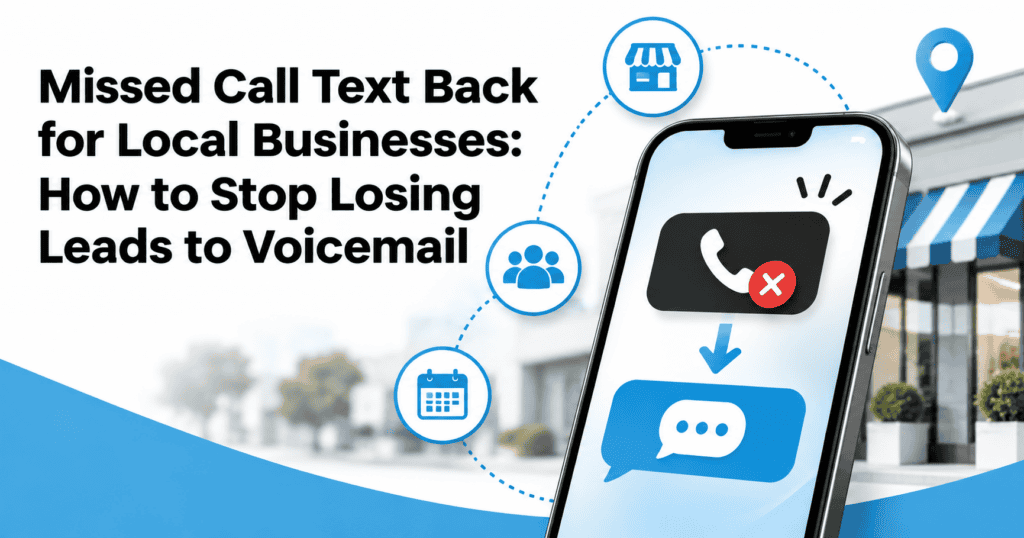
Missed call text back is an automation that detects when a call to your business goes unanswered and immediately sends the caller a text message from your business number. The text acknowledges the call, tells them you will get back to them, and usually asks a simple question that starts a conversation. Instead of a dead-end voicemail, the caller gets a reply within seconds.
The mechanics are simple:
Step 1: A call comes in and goes unanswered. You were busy, on another line, or outside business hours.
Step 2: The system detects the miss. This happens instantly, usually within a few seconds of the call ending.
Step 3: A text goes out from your business number. The message is personalized with your company name and written to sound like a real person, not a robocall.
Step 4: The caller replies and the conversation starts. From there, you or an AI Employee can qualify the request, answer basic questions, and move the lead toward a booked appointment.
Why Missed Calls Cost Local Businesses So Much
Local service customers are not browsing. A homeowner with a dead air conditioner, a leaking pipe, or a tripping breaker is trying to solve a problem today. They usually contact two or three businesses at once and book with whoever responds first and sounds competent. Speed is not a nice-to-have in this market. It is the deciding factor.
Voicemail Is Where Leads Go to Die
Many callers simply will not leave a voicemail, especially younger homeowners who rarely use voicemail themselves. Those who do leave one are often cold by the time you call back. Meanwhile, the caller who got an instant text from a competitor is already in a conversation. By the time you return the call, the job is gone, and the only evidence is a missed call entry in your log.
The Math Is Uncomfortable
Take a business that averages 200 inbound calls a month and misses 25 percent of them. That is 50 missed calls. If even a third of those callers were genuine buyers and your average job is worth $500, you are leaving roughly $8,000 a month on the table. For businesses with higher ticket sizes such as roofing, solar, or major HVAC replacement, the same math produces numbers that should get an owner’s attention immediately.
Your own numbers will differ, but the exercise is worth doing. Pull your call log for the last 30 days, count the unanswered calls, and multiply by a conservative close rate and your average job value. Most owners are surprised.
After-Hours Calls Are Not Low-Quality Calls
Many of the most valuable calls arrive in the evening or on weekends, because that is when homeowners are home, notice the problem, and have time to deal with it. A business that goes silent at 5 p.m. is invisible to a large share of its best leads. Automatic text back keeps you responsive around the clock without anyone staying on call.
What a Good Missed Call Text Looks Like
The difference between a text that books jobs and a text that gets ignored is tone. It should read like a message from a person at your company, short and specific, with one clear question.
A weak example: “Thank you for contacting ABC Plumbing. We are currently unavailable. Please leave a message or visit our website.”
That message sounds like an answering machine. It asks nothing of the caller and gives them no reason to reply.
A strong example: “Hey, this is Mike at ABC Plumbing. Sorry we missed your call! What’s going on, and is it an emergency or can it wait until tomorrow?”
This one is human, it names a person, and it asks a question that is easy to answer in one line. The reply tells you urgency, which lets you prioritize the leads that need immediate attention.
A few principles that keep these messages working:
Keep it under 160 characters when possible. Shorter texts get read and answered more often.
Ask one question, not three. Make replying effortless.
Use a real first name. A name makes the message feel personal and builds trust before the first conversation.
Match your voice. If your brand is casual and friendly, the text should be too. If you serve a more formal market such as legal or dental, adjust the language accordingly.
Missed Call Text Back vs. Voicemail vs. Answering Services
Business owners usually have three options for calls they can’t take, and each solves a different problem.
Voicemail
Free and universal, but passive. It depends on the caller doing the work of leaving a message, and it depends on you remembering to return it quickly. For competitive local markets, that is a losing combination.
Live Answering Services
A human answers on your behalf, which can work well, but it is a recurring cost that scales with call volume, and the quality varies widely. Callers can tell when they are talking to a generic call center that does not know your business.
Missed Call Text Back
Low cost, instant, and conversational. It does not replace a live person for every situation, but it catches the leads that would otherwise vanish and keeps the conversation alive until you can step in. For most small and mid-sized service businesses, it delivers the best balance of cost and results. Many businesses combine it with an AI-driven follow-up system so that the text is the start of a qualified conversation rather than a single message.
How to Set Up Missed Call Text Back
The setup is not complicated, but a few details determine whether it works well.
1. Use a Business Number That Can Send Texts
The automation needs to run on a number that supports both calls and SMS. If your published business number is a landline, it typically has to be set up so that texts can be sent from it, or you need a tracked number that forwards to your phone.
2. Register for Business Texting
In the United States, businesses that send texts through software generally need to complete carrier registration, commonly called A2P 10DLC. Skipping this can lead to blocked or filtered messages. It is a one-time process, and a competent provider will handle it for you.
3. Write Your Message and a Few Variations
Draft one version for business hours, one for after hours, and one for weekends. After-hours messages can set expectations (“We’ll text you first thing at 7:30 tomorrow”) while still inviting the customer to describe their problem.
4. Decide What Happens After They Reply
This is where most setups fall short. A text that starts a conversation nobody answers is worse than no text at all. Decide who monitors replies, how quickly they will respond, and when the conversation moves to a phone call or a booking link. Automating the middle of the conversation with an AI Employee that asks qualifying questions and offers appointment times means no lead waits on you.
5. Include an Opt-Out and Keep Consent in Mind
Texting rules exist to protect consumers. Respect opt-out requests immediately, avoid sending marketing messages to people who haven’t agreed to receive them, and talk to a qualified attorney if you have questions about your specific obligations. A responsive text to someone who just called you is generally a service interaction, but the details matter.
Common Mistakes to Avoid
Sounding like a robot. If the message reads like an automated notice, people treat it like spam. Write it like a person would.
Never following up. Auto-replies are the opening move, not the whole game. Leads who do not respond to the first text often respond to a second message the next day.
Sending it to existing customers by accident. A returning customer who calls and gets a generic “thanks for contacting us” message feels ignored. Good systems recognize known contacts and adjust the message.
Ignoring the data. Missed call text back creates a record of every missed opportunity and what happened to it. Review it monthly so you can see how many calls were recovered and how many turned into booked jobs.
Who Benefits Most
Any business that depends on inbound phone calls benefits, but the effect is strongest for trades and service businesses where the owner or technicians are in the field all day. HVAC companies and plumbers deal with urgent calls at unpredictable hours. Roofers and other contractors are often on job sites where answering the phone is impractical. In each case, a fast, friendly text keeps the lead warm until someone can step in.
Missed Call Text Back Is One Piece of a Bigger System
Recovering missed calls only helps if people are calling in the first place. That is why we pair lead response with visibility: Google Business Profile optimization and review management bring more of the right customers to your phone, and automated follow-up makes sure none of them slip through. Together they form the foundation of the LionBear AI Marketing System, where every call, form, and chat is captured, answered, and tracked.
If you want to see how many leads your current setup is losing, start with a free look at where you stand today. Get Your Free Visibility Report to see how your business shows up in Google and AI search, then talk with our team about what a complete lead response system would look like for your business.