
 Search Engine Optimization
 Google Maps Ranking
 Google Ads
 Meta Ads
 SEO Websites
 AI Websites
 AI Blog
 AI Guides
 Chiropractors
GEO vs SEO: What’s the Difference and Why It Matters for Local Businesses
For years, businesses focused almost entirely on SEO.
The objective was simple: rank higher in Google, generate more traffic, and convert visitors into customers.
That strategy still works.
However, the way people search for information is changing rapidly.
Millions of users are now asking questions directly to AI-powered platforms like ChatGPT, Google AI Overviews, Gemini, Claude, and Perplexity.
Instead of searching through multiple websites, consumers can simply ask:
- Who is the best roofer near me?
- What HVAC company should I hire?
- Who has the best reviews in my area?
- Which contractor is most trusted locally?
AI platforms often provide direct answers instead of traditional search results.
This shift has introduced a new concept called Generative Engine Optimization, commonly known as GEO.
Businesses that understand GEO today will be better positioned as AI search continues to grow.
What Is GEO?
GEO stands for Generative Engine Optimization.
It refers to the process of improving a business’s visibility within AI-generated answers and recommendations.
Rather than focusing solely on ranking webpages, GEO focuses on helping AI systems understand, trust, and recommend your business.
When someone asks ChatGPT a question, the AI must decide which businesses deserve to be mentioned.
That decision is based on trust signals, authority, content, reviews, reputation, and relevance.
GEO helps strengthen those signals.
Many businesses are implementing GEO through comprehensive AI Search Optimization strategies that improve visibility across AI-powered search platforms.
What Is SEO?
SEO stands for Search Engine Optimization.
SEO focuses on improving a website’s visibility in traditional search engines such as Google and Bing.
The goal is to rank higher for specific keywords.
For example:
- Roofing company near me
- HVAC repair
- Plumber in San Diego
- Emergency electrician
SEO strategies typically include:
- Keyword research
- Content creation
- Technical SEO
- Backlinks
- Internal linking
- Local SEO
- Website optimization
SEO remains one of the most effective digital marketing strategies available today.
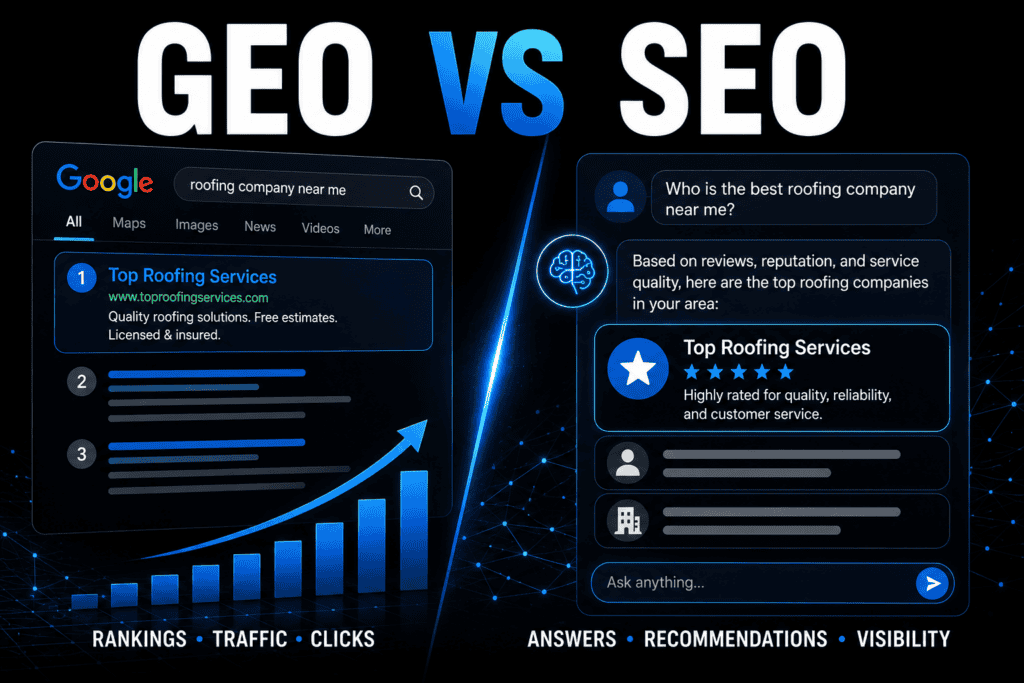
The difference is that SEO focuses on rankings, while GEO focuses on recommendations.
GEO vs SEO: Understanding the Key Differences
Although GEO and SEO share many similarities, they are not identical.
Understanding the differences helps businesses build a more complete online marketing strategy.
SEO Focuses on Rankings
Traditional SEO is designed to improve a website’s position within search engine results pages.
The objective is to move from page two to page one.
Or from position ten to position three.
Success is often measured through:
- Rankings
- Organic traffic
- Clicks
- Conversions
Businesses invest heavily in SEO because higher rankings generally lead to more opportunities.
GEO Focuses on Recommendations
GEO is focused on increasing the likelihood that AI systems mention, reference, or recommend a business.
Instead of asking:
“How do I rank this page higher?”
GEO asks:
“How do I become the business AI recommends?”
This subtle shift changes the way businesses think about authority.
SEO Optimizes Pages
SEO focuses heavily on individual pages.
Each page targets specific keywords and search intent.
Examples include:
- Service pages
- Location pages
- Blog posts
- Landing pages
SEO success often comes from optimizing content around keywords.
GEO Optimizes Authority
GEO takes a broader view.
AI systems evaluate overall authority rather than focusing solely on individual pages.
Authority can be influenced by:
- Reviews
- Reputation
- Citations
- Brand mentions
- Content quality
- Local relevance
This is why many businesses investing in AI Search Optimization place significant emphasis on building trust signals.
SEO Drives Traffic
Traditional SEO is designed to drive traffic to a website.
Users search.
They click.
They visit a webpage.
The website becomes the destination.
GEO Drives Visibility
With GEO, visibility can occur before a user visits your website.
A customer may ask ChatGPT a question and receive your business name directly in the answer.
This creates awareness before the searcher even clicks a link.
Why GEO Is Becoming Important
AI search adoption continues to grow.
Consumers increasingly prefer immediate answers.
Instead of browsing through multiple websites, they simply ask AI tools for recommendations.
This behavior is changing how businesses generate visibility online.
Companies that invest only in traditional SEO may miss opportunities to appear in AI-generated recommendations.
Businesses investing in How To Rank In ChatGPT strategies are already adapting to this shift.
How ChatGPT, Gemini, and AI Search Use GEO Signals
AI platforms evaluate information from numerous sources.
These may include:
- Business websites
- Google Business Profiles
- Review platforms
- Industry directories
- News articles
- Local citations
- Authority websites
- Brand mentions
AI systems use these signals to determine which businesses deserve to be recommended.
The stronger your authority, the more likely you are to appear in AI-generated responses.
This is one reason why review management remains so important.
Positive reviews help establish trust with both consumers and AI systems.
What GEO And SEO Have In Common
Despite their differences, GEO and SEO rely on many of the same foundational elements.
Both benefit from:
- High-quality content
- Strong reviews
- Website authority
- Backlinks
- Local SEO
- User experience
- Brand trust
Businesses with strong SEO foundations often have a head start when implementing GEO.
For a deeper comparison, see AI Search Optimization vs SEO.
Why Local Businesses Need Both GEO And SEO
Many business owners ask whether they should focus on GEO or SEO.
The answer is both.
SEO helps businesses rank in traditional search engines.
GEO helps businesses appear in AI-generated recommendations.
Together, they create a stronger digital presence.
For example:
A roofing company may rank highly in Google while also appearing in ChatGPT recommendations.
An HVAC company may receive traffic from search engines while simultaneously gaining visibility through AI answers.
The most successful businesses will leverage both strategies.
How To Improve GEO Visibility
Build Strong Authority
Authority remains one of the strongest GEO signals.
Businesses can strengthen authority through:
- Content creation
- Backlinks
- Industry recognition
- Reviews
- Brand mentions
The stronger your authority becomes, the easier it is for AI systems to trust your business.
Generate More Reviews
Reviews continue to influence both traditional search and AI search.
Businesses should actively pursue customer feedback and implement effective review management systems.
More positive reviews generally lead to stronger trust signals.
Create Helpful Content
Content remains critical.
AI systems rely on content to understand your expertise.
Publishing articles, guides, FAQs, and educational resources helps establish authority within your industry.
Businesses investing in AI Search Optimization often create content clusters around their core services.
Strengthen Local Signals
Local authority remains important for service-based businesses.
This includes:
- Google Business Profile optimization
- Local citations
- Service area pages
- Local backlinks
Many of these strategies overlap with Google Maps Ranking initiatives.
Improve Brand Mentions
The more often reputable sources mention your business, the stronger your overall authority becomes.
Brand mentions can come from:
- Industry websites
- Local news publications
- Business directories
- Community organizations
These signals help AI systems recognize your business as a trusted source.
Common GEO Mistakes Businesses Make
Many businesses struggle with GEO because they:
- Ignore reviews
- Have outdated websites
- Publish little content
- Lack authority signals
- Have inconsistent business information
- Fail to optimize local visibility
Businesses investing in modern AI-powered websites often gain an advantage because their websites provide stronger trust and usability signals.
The Future Of GEO And AI Search
AI search is still evolving.
However, one trend is becoming clear.
Consumers increasingly want direct answers.
Businesses that build authority today will be better positioned tomorrow.
Just as SEO became a competitive advantage years ago, GEO is emerging as a new opportunity for businesses willing to adapt early.
The future is not GEO versus SEO.
The future is GEO plus SEO.
Businesses that combine both strategies will be best positioned for long-term visibility.
Get Your Free AI Visibility Report
Want to know how your business appears in ChatGPT, Google AI Overviews, and other AI-powered search experiences?
LionBear.ai helps local businesses improve visibility through AI Search Optimization, Google Maps Ranking, AI-powered websites, meta ads, google ads, and review management.
Get your free AI Visibility Report today at lionbear.ai/book.
Frequently Asked Questions
What does GEO stand for?
GEO stands for Generative Engine Optimization, which focuses on improving visibility within AI-generated answers and recommendations.
Is GEO replacing SEO?
No. GEO complements SEO. Businesses should invest in both strategies to maximize visibility.
Does ChatGPT use GEO?
ChatGPT does not directly use GEO, but GEO strategies help improve the authority signals AI systems rely on when generating recommendations.
Can local businesses benefit from GEO?
Yes. GEO can help local businesses increase visibility within AI-generated answers and recommendations.
Should I focus on GEO or SEO?
The best strategy is to combine both. SEO improves traditional search visibility while GEO improves visibility within AI-powered search experiences.