
 Search Engine Optimization
 Google Maps Ranking
 Google Ads
 Meta Ads
 Microsoft Ads
 SEO Websites
 AI Websites
 AI Blog
 AI Guides
 Chiropractors
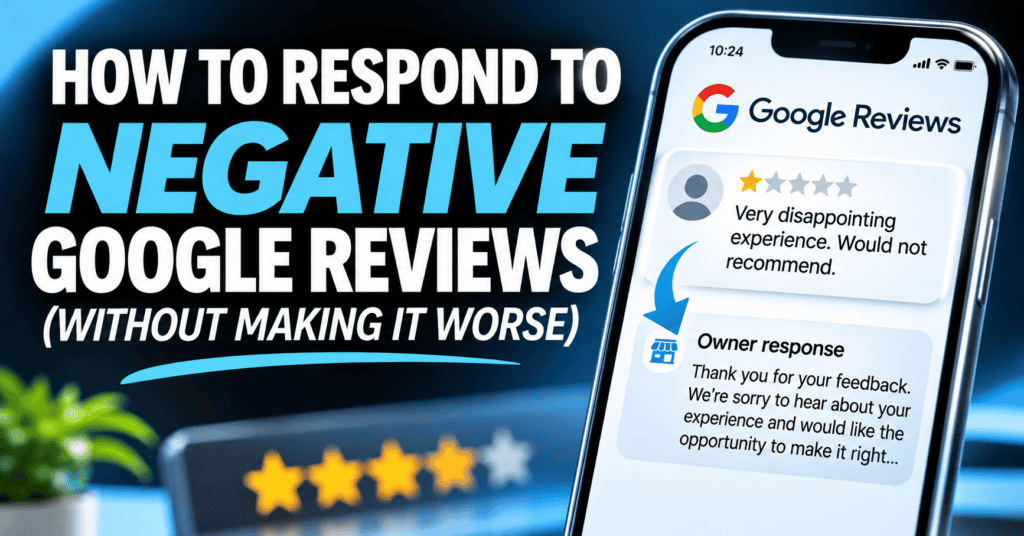
How to Respond to Negative Google Reviews (Without Making It Worse)
Few things sting like a one-star review on a business you built yourself. The first instinct is usually to defend yourself, correct the record, or hit back. That instinct is almost always wrong. Knowing how to respond to negative Google reviews is one of the most valuable reputation skills a local business owner can develop, because the response is rarely written for the reviewer. It is written for the hundreds of future customers who will read both sides before they decide whether to call you.
This guide gives you a practical framework, real examples, and the situations that call for something different, including fake reviews, abusive reviews, and reviews that are partly fair.
Why Your Response Matters More Than the Review
Most people reading a negative review are not the reviewer. They are prospects deciding whether to trust you, and they know that no business is perfect. What they are looking for is how you behave when something goes wrong. A calm, professional reply signals that you take responsibility and care about customers. A defensive or hostile reply signals the opposite and can do more damage than the original complaint.
There are also practical reasons to respond. Google has said that responding to reviews can be a signal of a well-run business profile, and customers consistently say they trust businesses that engage. Review engagement also feeds into how your profile looks overall, which supports your Google Maps ranking and the signals AI systems use when deciding which businesses to recommend.
The Five-Part Framework for Responding
Almost every effective response to a legitimate negative review follows the same structure.
1. Pause Before You Write
Do not respond while you are angry. Read the review, then step away for a few hours if you need to. Check your records so you know what actually happened. A fast response is good, but a thoughtful one posted the next morning is far better than a heated one posted immediately.
2. Thank Them and Use Their Name
Begin with a simple acknowledgment. “Thank you for the feedback, Sarah.” It feels counterintuitive, but opening with appreciation lowers the temperature for both the reviewer and everyone watching.
3. Acknowledge the Experience Without Arguing
You do not have to agree with every detail to show empathy. “I’m sorry your appointment didn’t go the way you expected” acknowledges their experience without admitting fault or starting a debate. Avoid phrases like “as we explained” or “you should have,” which read as blame.
4. Offer a Specific Next Step
Give the reviewer a direct way to resolve the issue, ideally offline. “Please call me directly at this number so I can make this right” shows action, and it moves the details of the dispute out of public view.
5. Keep It Short
Three to five sentences is plenty. Long replies look defensive, and short ones look confident. Never include private customer details, pricing disputes, or job specifics that the customer did not share publicly.
Examples You Can Adapt
A Service Complaint (Late Arrival)
Review: “Technician showed up two hours late and never called. Unprofessional.”
Response: “Thank you for letting us know, and I apologize for the wait. Not communicating about a delay is not the standard we hold ourselves to. I’d like to understand what happened and make sure it doesn’t repeat. Please call me directly at [phone number] or reply here with the best way to reach you. Thank you for giving us the chance to improve.”
A Pricing Complaint
Review: “Way overpriced for what they did.”
Response: “We appreciate you sharing this, and we understand that price matters. We aim to explain every estimate before work begins, so we’d like to review the details with you and make sure the invoice reflected what was agreed. Please contact our office at [phone number] and ask for me, and we’ll go through it together.”
A Review That Is Partly Fair
Review: “The work was fine but the office was hard to reach and scheduling was a mess.”
Response: “Thank you for the honest feedback. We’re glad the work met your expectations, and you’re right that scheduling and communication need to be better. We’ve been working to improve how quickly we respond, and your comment helps. If you’d like to talk about your experience, please call [phone number].”
Notice what each response does: it never argues, it never reveals private details, and it demonstrates a business that listens. Someone skimming reviews before booking sees a company they can trust to treat them fairly if something goes wrong.
What Not to Do
Don’t argue the facts in public. Even if you are right, a point-by-point rebuttal usually reads as hostile. If you need to clarify something factual, do it briefly and politely.
Don’t use templates that sound like templates. Copy-and-paste replies are obvious when they stack up on a profile. Customize at least the first and last sentence.
Don’t offer incentives for removing or changing a review. Asking for removal in exchange for refunds or discounts can violate Google’s policies and looks desperate.
Don’t ignore the review. Silence can look like indifference. An unanswered one-star review sits there making its own case.
Don’t respond in anger or sarcasm. You will not win the argument, and you will lose the audience.
When a Review Is Fake, Abusive, or Violates Policy
Not every negative review deserves a conversation. Some should be reported.
Signs a Review May Be Fake
The reviewer has no history, describes a service you don’t offer, has no matching customer record, or appears to be from a competitor or former employee. Search your records before assuming. Sometimes a customer reviewed under a different name.
How to Flag It
From your Google Business Profile, you can flag a review as inappropriate and select the policy it violates, such as fake engagement, off-topic content, or harassment. Removal is not guaranteed and can take time, so document the reasons and be patient. While you wait, post a short, neutral public reply: “We have no record of this customer or this service. Please contact us directly so we can look into it.” That tells readers you are paying attention without escalating.
When It Gets Serious
Reviews that contain threats, hate speech, or defamatory claims may warrant further steps. For legal questions, consult an attorney. Do not take matters into your own hands by contacting the reviewer in a threatening way.
How Fast Should You Respond?
Aim to reply within one business day. A response posted within hours shows that someone is paying attention, which matters to prospects who see the review while it is still near the top of your profile. But speed should never beat accuracy or tone. If a review makes you angry, it is better to wait until the next morning than to post something you will regret. For serious complaints, such as safety issues or alleged damage, take the time to review your records, talk to the technician involved, and then reply with facts and a clear plan.
If a review sits unanswered for weeks, it is still worth replying. A late, thoughtful response is better than silence, and future readers will see the effort even if the original reviewer has moved on.
Should You Respond to Positive Reviews Too?
Yes. Replying to positive reviews takes less time than handling complaints, and it does three useful things. It thanks customers who took the time to write, which encourages them to refer others. It shows prospects that the business is active and engaged. And it gives you a natural place to mention the service and area in your own words, such as “Thank you, Dave, we’re glad we could get your furnace running again before the cold snap.” Keep these replies personal rather than copying the same line onto every review, since repeated identical responses look automated.
The Best Defense Is Review Volume
A single negative review hurts most when it sits among a handful of others. A business with 25 reviews and a 4.2 average is vulnerable to one bad experience. A business with 300 reviews and a 4.8 average barely notices it. Prospects see a negative review as normal in a large body of positive feedback, and some research suggests that a few critical reviews even make a profile feel more authentic.
That is why consistent review generation is the strongest long-term reputation strategy. Asking every happy customer at the right moment, immediately after a completed job, builds a buffer that no single complaint can break. Our review management system automates those requests so volume builds steadily while you focus on the work. The same reviews also strengthen your Google Business Profile and give AI search tools more positive evidence to draw from when recommending businesses.
Build a Simple Process So You Never Panic
A small amount of preparation makes every negative review easier to handle. Decide who owns review responses, whether that is you, a manager, or an assistant. Set a target response time, ideally within one business day. Keep two or three response outlines on hand that you can personalize. And designate a person who calls unhappy customers directly, because the most effective resolution happens off the platform.
Also consider the cause. If the same complaint appears repeatedly, whether it is late arrivals, unclear pricing, or poor phone follow-up, the review is data. Fixing the underlying problem is the only thing that stops the next one. Many of these issues trace back to slow lead response, which is why businesses often combine reputation work with an AI Employee that answers inquiries instantly and keeps customers informed.
Want to know how your reviews and profile compare to local competitors? Get Your Free Visibility Report, then talk with our team about a reputation and review plan built for your business.