
 Search Engine Optimization
 Google Maps Ranking
 Google Ads
 Meta Ads
 SEO Websites
 AI Websites
 AI Blog
 AI Guides
 Chiropractors
Missed Call Text Back: Why Every Local Business Needs This
Your phone rings. You’re on a job, in a meeting, or it’s after hours. The call goes unanswered. The customer hangs up — and instead of leaving a voicemail, they call the next business on the list.
This happens constantly across local service businesses, and most owners have no idea how many jobs it costs them, because there’s no record of a missed call turning into a lost customer. It just looks like silence.
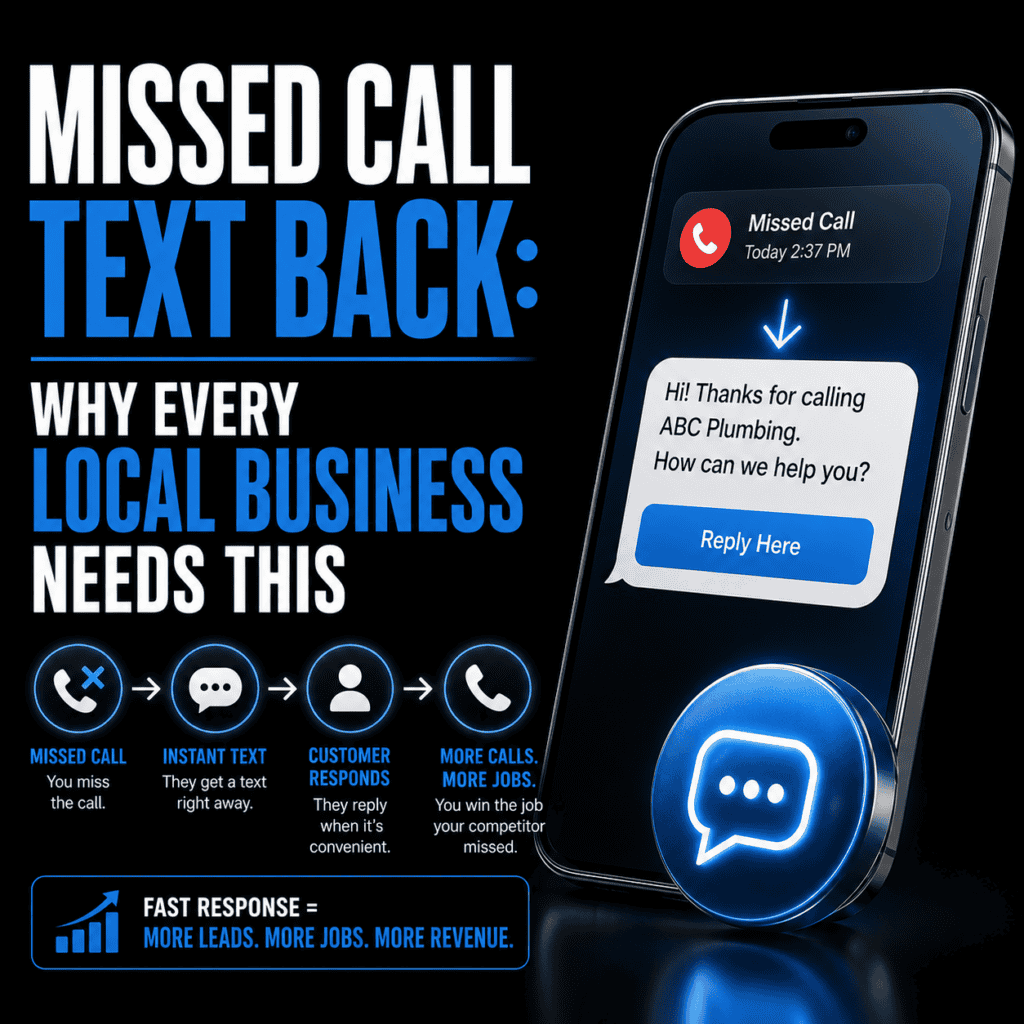
Missed call text back is a simple, specific piece of automation that closes this gap. The moment a call goes unanswered, the system automatically sends a text message to the caller — keeping the conversation alive instead of letting it disappear. AI Employee helps business answer calls and respond via sms.
What Missed Call Text Back Actually Does
When an inbound call to your business goes unanswered — whether because no one picked up, the line was busy, or it happened outside business hours — the system immediately sends an automated text message to that caller’s number.
A typical message looks something like: “Hey, sorry we missed your call! This is [Business Name] — we’re on it. What can we help you with?”
The message is sent within seconds of the missed call, with no action required from anyone on your team. The customer, instead of getting silence or a generic voicemail prompt, gets an immediate, human-sounding response that keeps the door open.
Why This Matters So Much for Local Businesses
A huge percentage of local business calls go unanswered for completely normal reasons. Technicians are on job sites. Staff are helping another customer. Calls come in after hours, on weekends, or during lunch. None of this reflects poorly on the business — but to the caller, an unanswered phone often reads as “this business isn’t available,” and they move on to the next search result.
Research on consumer behavior consistently shows that most callers who don’t reach a business simply call a competitor rather than leaving a voicemail. Voicemail has a low follow-through rate precisely because it requires the business to call back, and by the time that happens, the moment of intent has often passed.
Missed call text back interrupts that pattern. Instead of the caller’s next action being “call someone else,” it becomes “respond to this text,” which keeps the conversation — and the opportunity — alive.
The Real Cost of Not Having This
Consider a home service business that receives 25 missed calls per month — a realistic number for a business with a small team handling both fieldwork and incoming calls. If even 40% of those calls would have converted to a booked job with a fast enough response, that’s 10 potential jobs slipping away every month.
At an average job value of $600, that’s $6,000 per month in opportunity that never even shows up as a loss anywhere in the business’s numbers, because there’s no record that the lead ever existed in the first place.
Missed call text back doesn’t require new ad spend or additional leads. It captures more value from calls the business is already receiving.
How Missed Call Text Back Fits Into a Complete Follow-Up System
Missed call text back is most effective as one piece of a broader automated follow-up system rather than a standalone fix. Once the initial text reopens the conversation, the same logic that applies to automated lead follow-up from web forms applies here too — if the caller doesn’t respond right away, a short follow-up sequence over the next several days keeps the door open without anyone on your team having to remember to text them again.
If the caller does respond, the conversation gets flagged for your team to take over immediately, since it’s now a warm, two-way conversation rather than a missed call sitting in a call log.
What Makes a Good Missed Call Text Back Message
The message should sound like a real person reaching out, not an automated system. Short, conversational, and specific to the fact that a call was just missed works far better than a generic “Thanks for contacting us” message that could apply to any inquiry.
It should also make it easy for the caller to respond in whatever way is most convenient — replying by text, requesting a callback, or being given a link to book directly. Removing friction at this stage matters, because the caller is often still in the same moment of need that prompted the original call.
Who Benefits Most From This
Missed call text back delivers the clearest value for businesses where phone calls are a primary lead source and where staff are frequently unavailable to answer in real time — home service businesses like plumbers, HVAC companies, electricians, and roofers; medical and dental practices with front-desk staff handling multiple calls at once; and any local business operating with a small team that can’t realistically staff a phone line at all hours.
The Bottom Line
Missed call text back is one of the simplest, lowest-effort pieces of automation a local business can implement — and one of the most directly tied to recovering revenue that’s currently disappearing without a trace. It doesn’t require generating more leads. It just makes sure the leads you’re already getting don’t walk away from a moment of silence.
Want to see how missed call text back and the rest of an automated follow-up system would work for your business? Book a free demo — or get your free AI visibility report to see where else you might be losing leads.