
 Search Engine Optimization
 Google Maps Ranking
 Google Ads
 Meta Ads
 Microsoft Ads
 SEO Websites
 AI Websites
 AI Blog
 AI Guides
 Chiropractors
Schema Markup for Local Businesses: What It Is and Why AI Search Needs It
When a person reads your website, they understand it instantly. A search engine or AI system has to work harder. It has to guess which phrase is your business name, which number is your phone line, which towns you serve, and which page describes which service. Schema markup for local businesses removes the guesswork. It is a layer of structured code that tells machines exactly what your business is, what you offer, and where you operate, in a format they can read without interpretation.
This guide explains schema in plain language, covers the types that matter most for service businesses, and shows how to implement it without breaking your site. It is more technical than most of our posts, but you do not need to be a developer to follow it.
What Is Schema Markup?
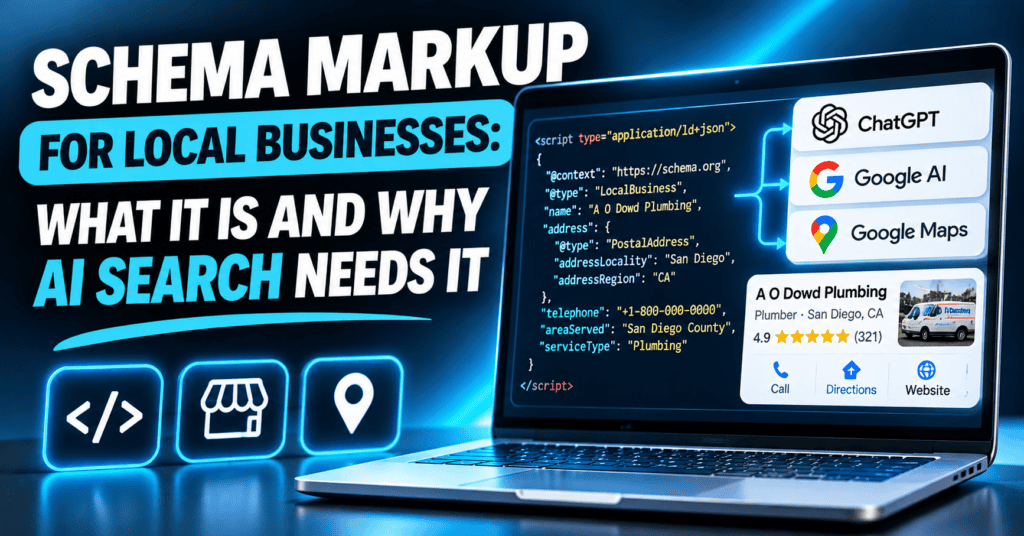
Schema markup is a standardized vocabulary, maintained at Schema.org, that describes the content of a web page. It is usually added to a page as a block of JSON-LD code. Visitors never see it, but search engines and AI tools read it when they crawl your page.
A simple example is a block that says: this page describes a business of the type “Plumber,” named “ABC Plumbing,” with this phone number, this address, these opening hours, and these service areas. Instead of inferring those facts from paragraphs of text, a machine reads them directly.
Schema does not make a weak page rank. What it does is reduce ambiguity, which helps search engines and AI systems categorize your business correctly and feel confident enough to surface it.
Why Schema Matters More in the Age of AI Search
Traditional SEO used schema mainly to earn rich results such as star ratings and FAQ dropdowns. That is still part of the picture, though Google has narrowed which rich results appear for which sites. The bigger shift is that AI-driven search relies on entities: clearly defined things with clear attributes. When someone asks an AI assistant for a recommended electrician, the system is effectively asking, “Which businesses do I know are electricians, in this area, with good reputations?”
Structured data helps answer that question cleanly. It reinforces the same facts your Google Business Profile, directory listings, and website content already state, and consistency across those sources is one of the strongest trust signals you can build. That is a core part of how we approach AI search optimization: clear entity signals everywhere a machine might look.
To be clear, no one outside the search platforms can promise that schema directly causes an AI recommendation. What we can say is that structured, consistent, machine-readable information makes your business easier to understand, and understanding comes before recommendation.
The Schema Types That Matter for Local Service Businesses
There are hundreds of schema types, but a handful do most of the work for local companies.
LocalBusiness (and Its Subtypes)
This is the foundation. LocalBusiness describes your company with its name, address, phone number, hours, logo, website, and geographic service area. Schema.org also offers more specific subtypes, such as Plumber, Electrician, HVACBusiness, RoofingContractor, Dentist, and LegalService. Use the most specific subtype that accurately describes you. Keep the name, address, and phone number identical to your Google Business Profile, character for character.
Service
Each major service page should describe the specific service it covers: what it is, who provides it, and the area it is available in. A water heater replacement page, for example, can be marked up as a Service offered by your business. This helps tie individual pages to your core entity.
Organization and Person
Organization markup defines your brand at the company level and can link out to your official profiles on other platforms. Person markup is useful for an About page, especially when the owner or lead practitioner is a recognized face of the business. Both strengthen the connection between your brand, your people, and your expertise.
FAQPage
If a page contains real questions and answers, FAQPage markup labels them as such. Google now shows FAQ rich results for a limited set of sites, so do not add FAQ schema purely to get dropdowns. The value is that it presents your answers in a clean question-and-answer structure, which is exactly the format answer engines favor. Only mark up questions that actually appear on the page, in the visible content.
Article or BlogPosting
For blog content like this post, Article markup identifies the headline, author, publisher, and publication date. It helps search and AI systems attribute content to the right source and judge how recent it is.
Reviews and Ratings: Handle With Care
Many businesses are tempted to mark up their own reviews to display stars in search results. Google’s guidelines generally do not allow self-serving review markup for a business’s own LocalBusiness or Organization pages, and violations can lead to the markup being ignored or a manual action. Use review markup only where the guidelines allow it, and rely on your Google Business Profile for the stars customers see in search.
What Good LocalBusiness Schema Includes
A strong LocalBusiness block typically covers:
Name and business type using the most specific subtype available.
Address and phone identical to your Google Business Profile.
Opening hours that match what customers see on Google, including after-hours or emergency availability if you offer it.
Service area listing the cities, counties, or regions you serve. This is especially important for service-area businesses that travel to customers.
Logo and images pointing to real files on your site.
The sameAs property linking to your official profiles, such as your Google Business Profile, Facebook page, LinkedIn, and major directory listings. This connects the dots between your website and the rest of your online presence.
How to Add Schema to a WordPress Site
You have three practical options, depending on your comfort level.
Option 1: Use Your SEO Plugin
Popular WordPress SEO plugins, including Rank Math, include schema builders for common types such as Service, Person, and Article. This is the easiest route and works well for blog posts and basic pages. Check that the output uses your real business details and that you have not accidentally created duplicate or conflicting markup on the same page.
Option 2: Paste JSON-LD Into the Page
For types your plugin does not cover, such as a detailed LocalBusiness block or FAQPage markup, you can paste a JSON-LD script into an HTML block or a custom code field. It is reliable and gives you full control, but it needs care. A missing comma can invalidate the whole block.
Option 3: Have It Built Into the Site
The cleanest approach is a site built with structured data as part of its foundation, so every page has the right markup from day one and stays consistent as you add content. That is how our AI websites are built, with schema, clean content structure, and fast performance as standard parts of the build.
How to Test Your Schema
Never publish markup without testing it. Two free tools do the job:
Google’s Rich Results Test checks whether a page’s markup is valid and whether it qualifies for rich results.
The Schema.org validator checks the structure against the full vocabulary, which is useful for types that don’t trigger rich results.
Run both after adding or editing markup, fix any errors, and re-test after major site changes. Also check Google Search Console’s enhancement reports, which flag structured data problems across the site over time.
Common Schema Mistakes
Marking up content that isn’t on the page. Schema must reflect what visitors can actually see. Hidden or misleading markup can be penalized.
Inconsistent business details. If your schema says one phone number and your Google Business Profile says another, you are creating exactly the ambiguity schema is supposed to remove.
Using a generic type when a specific one exists. “LocalBusiness” works, but “Electrician” or “RoofingContractor” is clearer.
Stacking duplicate markup. Themes, plugins, and manual code can each add their own versions. Conflicting blocks confuse parsers.
Treating schema as a one-time task. Update it when your hours, services, or service area change.
A Simple Starter Plan
If you want to put schema to work without getting lost in the details, follow this order:
First, add LocalBusiness markup to your homepage. Use the most specific business type available and make sure every detail matches your Google Business Profile exactly.
Second, add Service markup to your main service pages. Start with the two or three services that bring in the most revenue.
Third, mark up your About page. Use Organization or Person markup to connect your brand to the people behind it and to your official profiles elsewhere on the web.
Fourth, add Article markup to your blog posts. Most SEO plugins handle this automatically once configured.
Fifth, test everything. Run each page through Google’s Rich Results Test, fix errors, and check Search Console for warnings a week or two later.
This sequence covers the markup that matters for most service businesses in an afternoon or two of work, and it gives you a clean base to build on as your site grows.
Schema Is One Layer, Not the Whole Strategy
Structured data helps machines understand you, but understanding is not the same as trust. Search engines and AI systems still weigh review volume, content depth, local relevance, and authority from mentions across the web. Schema works best as part of a complete approach that also includes strong search engine optimization, a fully built Google Business Profile, and consistent answer engine optimization so your content is structured the way AI tools like to quote it.
If you are not sure whether your site’s structured data is complete, correct, or even present, we can show you. Get Your Free Visibility Report to see how your business appears in Google and AI search, then talk with our team about closing the gaps.